



LED Photodynamic Therapy for Acne-Prone Skin: What Clinics and Distributors Should Know
2026-05-06 14:30LED Photodynamic Therapy for Acne-Prone Skin: What Clinics and Distributors Should Know Before Choosing a PDT System
LED photodynamic therapy is often discussed in acne care, but the term is not always used carefully. In clinical dermatology, photodynamic therapy usually refers to a light-based treatment used with a photosensitizing agent. In the medical device market, however, many professional LED light therapy systems are also described as “LED PDT” systems because they use controlled red, blue, yellow, green, or near-infrared light for skin treatment workflows.
That distinction matters. Acne-prone skin is not a simple cosmetic category, and light-based treatment should not be positioned as a quick substitute for diagnosis, topical therapy, oral medication, or structured dermatologic care. Current acne guidelines still place established medical treatments at the center of acne management, while light and laser-based approaches are discussed as options with variable evidence and practical limitations. The American Academy of Dermatology's acne guideline page emphasizes acne as a common inflammatory skin disease with potential scarring and psychosocial impact, while more recent reviews note that blue and red light may help some acne patients but should not be oversold as a standalone answer.
For clinics and distributors, the practical question is not whether LED PDT light therapy sounds attractive, but whether the system can support a real acne-prone skin workflow.
What LED PDT Actually Adds to Acne-Prone Skin Workflows
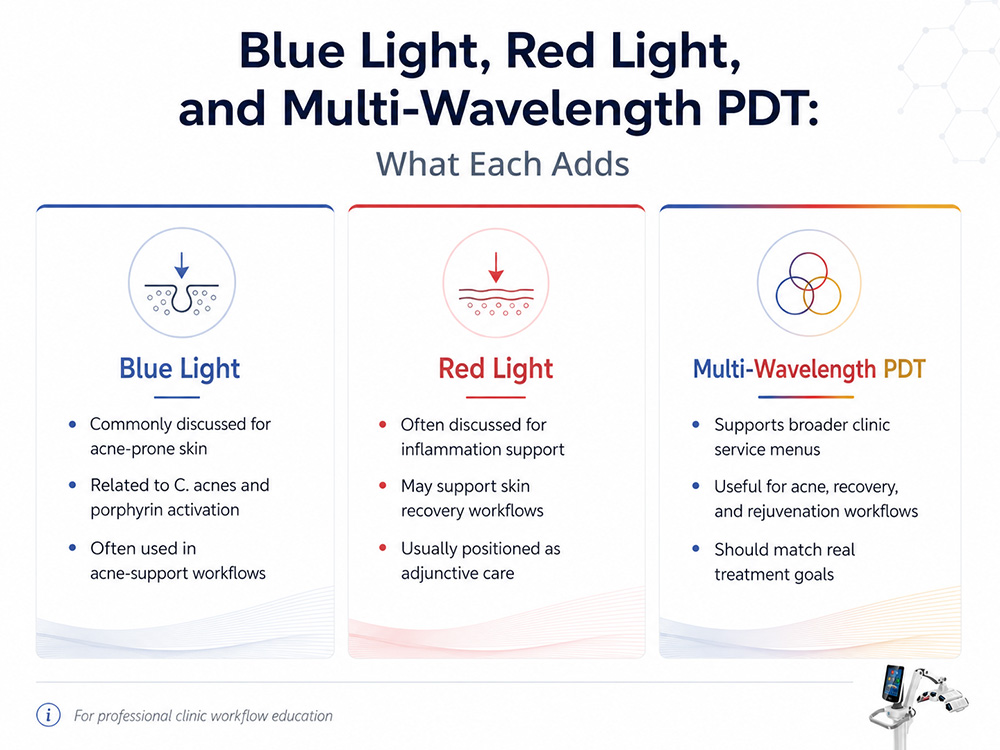
Blue and red light are the two wavelengths most often discussed in acne-related LED treatment. Blue light has been studied for its effect on Cutibacterium acnes through porphyrin activation, while red light is commonly discussed in relation to inflammation modulation and tissue response. A systematic review of blue-light therapy describes the 407–420 nm range as having a bactericidal effect on P. acnes, but also notes that treatment protocols and study designs vary.
Combination red and blue LED therapy has also been studied. A classic clinical study reported that combined blue and red light therapy was effective, safe, and non-painful for mild to moderately severe acne vulgaris. More recent reviews still describe light-based acne therapy as promising, but not uniformly strong enough to replace standard acne management.
This is the most credible way to talk about LED PDT for acne-prone skin: it may add value as part of a clinic’s broader acne and skin recovery pathway, especially when the clinic wants a noninvasive, repeatable, and adjustable light-based option. It should not be presented as a cure-all.
Where LED PDT May Be a Good Fit
LED PDT may be a reasonable fit for clinics that already manage acne-prone skin and want to broaden noninvasive treatment options. It may be especially relevant in dermatology clinics, medical aesthetics practices, and skin treatment centers where acne care, inflammation management, post-treatment recovery, and skin rejuvenation are already part of the service mix.
The modality may be useful when patients are looking for adjunctive care, when the clinic wants a non-drug supportive option, or when acne-prone skin is being managed alongside procedures that require recovery support. KernelMed's LED light therapy product category already reflects this kind of professional positioning, with systems listed for acne care, skin recovery, inflammation-related applications, and clinic-based skin treatment workflows.
The key is patient selection. LED PDT is easier to justify when the clinic can define who it is for, how sessions are scheduled, how outcomes are followed, and how it fits alongside standard acne management.
Where LED PDT Should Not Be Overstated
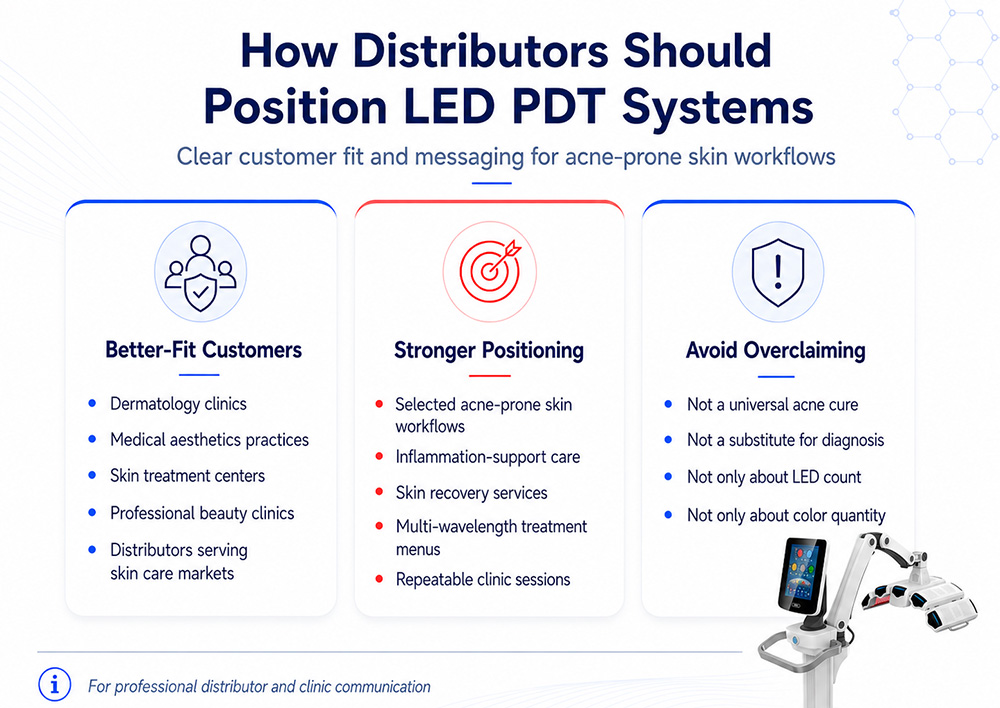
This point is important. LED PDT should not be sold as a universal acne treatment. Acne severity, lesion type, skin sensitivity, medication history, scarring risk, recurrence pattern, and patient expectations all matter. Light-based therapy may help some patients, but it is not automatically the best option for every acne case.
AAD patient education also warns that laser and light acne treatments are more involved than many people assume, and that results can be less predictable even when treatments are performed by dermatologists. It describes these therapies as a possible part of an acne treatment plan, not a simple one-step solution.
For distributors, this means avoiding exaggerated claims. The product should be positioned as a professional light-based system that supports selected clinic workflows, not as a guaranteed acne-clearing machine.
What Clinics Should Evaluate Before Choosing a PDT System
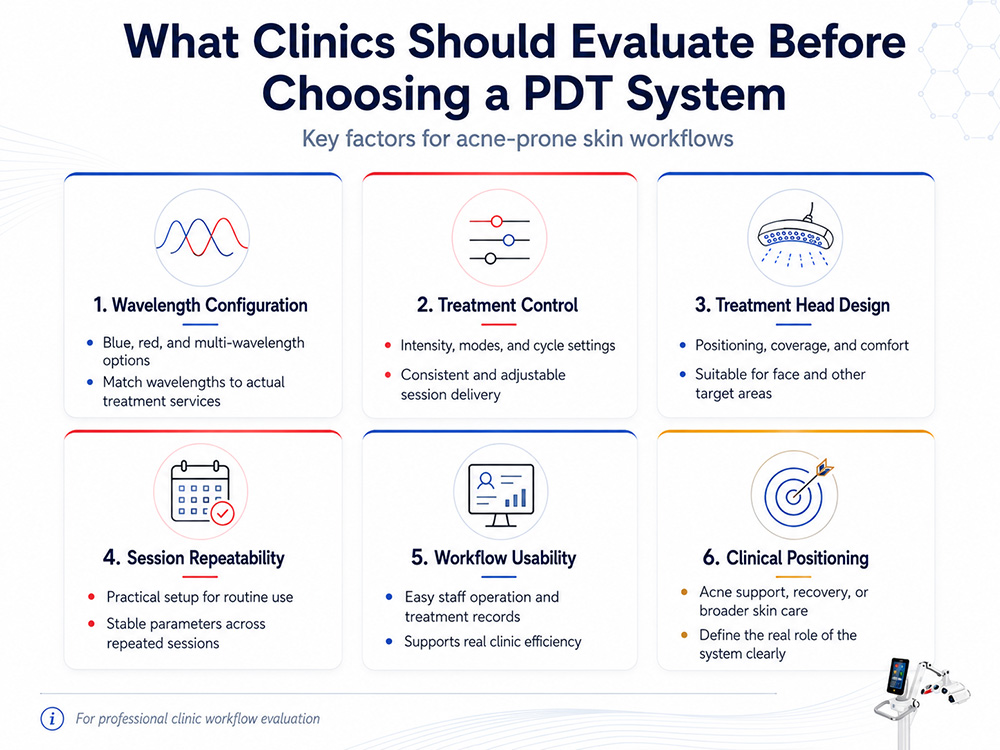
The first factor is wavelength configuration. Acne-related workflows often focus on blue and red light, but many clinic systems now include additional wavelength options such as yellow, green, or near-infrared depending on intended applications. More wavelengths are not automatically better. The real question is whether the available wavelength combinations match the clinic’s treatment services.
The second factor is treatment control. A professional LED PDT system such as the KN-7000L is better evaluated by wavelength options, irradiation modes, intensity control, treatment head design, and workflow usability rather than by appearance alone. The KN-7000L page positions the system around four-color LED light therapy, continuous and pulse irradiation modes, custom cycle irradiation, real-time intensity monitoring, and intelligent temperature control, which are all more relevant to clinical workflow than simple “beauty light” messaging.
The third factor is treatment area and head design. Acne-prone skin workflows may involve the face, jawline, neck, chest, or back depending on the patient group. A clinic should evaluate whether the treatment head can be positioned consistently and comfortably for the areas it plans to treat.
The fourth factor is session repeatability. LED therapy is rarely a one-time workflow. Clinics need practical session scheduling, consistent device settings, staff training, and documentation. A system that looks impressive but is difficult to set up repeatedly may not perform well in daily use.
The fifth factor is positioning. Clinics should be clear whether the system is being used for acne-prone skin support, inflammation management, recovery care, rejuvenation services, or a broader skin treatment menu. Mixing all claims into one message weakens credibility.
What This Means for Distributors
For distributors, the strongest customers are not necessarily those asking for the cheapest LED device. Better-fit customers are clinics that already provide acne care, medical aesthetics, post-procedure recovery, or noninvasive skin treatment services and need a professional system that fits a repeatable workflow.
For markets that focus more on acne care, skin rejuvenation, and professional beauty-treatment workflows, a PDT LED light therapy machine such as KN-7000A may be easier to position. The KN-7000A page describes it as a professional LED PDT light therapy system for acne-related care, skin rejuvenation support, inflammation management, and professional light-based skin treatment workflows; it also lists multiple color combinations and 1,820 high-power LEDs in a point-matrix arrangement.
For distributors targeting dermatology clinics or higher-spec medical aesthetic centers, KN-7000L may be positioned around multi-wavelength control, treatment modes, and system-level usability. For buyers seeking a more classic PDT machine with broad skin beauty applications, KN-7000A may be more straightforward. For acne treatment, inflammation support, and wound-healing support messaging, KN-7000D also has a clear page-level positioning.
The key is not to sell by model name alone. Sell by workflow fit.
Choosing Based on Workflow, Not Just Light Color
A common mistake in this category is to reduce product comparison to color: blue for acne, red for inflammation, yellow for repair, and so on. That kind of shortcut may be easy to explain, but it is too shallow for professional buyers.
Clinics should look at how the system will be used every week. Will the device support the patient types the clinic actually sees? Can the staff set treatment parameters consistently? Is the treatment head easy to position? Does the system support repeatable sessions? Does the clinic have a clear service plan, or is it simply adding another machine without a workflow?
Distributors should ask similar questions. Which customers already understand acne care and skin treatment services? Which customers need a premium system? Which markets are better suited for a classic PDT machine? Which buyers need OEM, training, or broader product-line support?
These are stronger questions than asking only how many LEDs a device has.
Conclusion
LED PDT can be a useful part of acne-prone skin and skin recovery workflows, but only when it is positioned realistically. For clinics, the value lies in controlled, repeatable, noninvasive light-based treatment that fits patient selection, treatment planning, and follow-up. For distributors, the opportunity lies in explaining where the system fits, which customer groups it serves, and why professional workflow matters more than broad cosmetic claims.
The best way to position LED PDT is not as a miracle acne solution. It is a professional light-based platform for clinics that need structured acne-prone skin, inflammation-support, recovery, and skin treatment workflows.
Explore KernelMed's LED light therapy systems for acne care, skin recovery, and professional clinic workflows.
FAQ
Is LED PDT the same as medical photodynamic therapy?
Not always. In strict clinical use, photodynamic therapy usually involves a photosensitizing agent and light activation. In the device market, “LED PDT” is often used to describe professional LED light therapy systems with red, blue, yellow, green, or near-infrared wavelengths. Clinics should be clear about which workflow they are offering.
Can LED light therapy help acne-prone skin?
Blue and red light therapies have shown potential benefit in acne care, especially for inflammatory acne, but evidence varies by device, protocol, acne severity, and treatment design. They should usually be positioned as part of a broader acne management plan rather than a standalone replacement for standard care.
What should clinics look for in an LED PDT system?
Clinics should evaluate wavelength configuration, treatment modes, intensity control, treatment head flexibility, session repeatability, safety design, staff usability, and whether the device fits real acne and skin recovery workflows.
Which wavelengths matter most for acne-prone skin?
Blue light and red light are the most commonly discussed for acne-related LED therapy. Blue light is associated with effects on C. acnes, while red light is often discussed for inflammation and tissue response. Multi-wavelength systems may support broader skin treatment workflows, but more colors do not automatically mean better outcomes.
How should distributors position LED PDT systems?
Distributors should position LED PDT systems by clinic workflow and customer type. Dermatology clinics, medical aesthetics practices, skin treatment centers, and distributors serving professional skin care markets may all need different messaging. Avoid presenting the device as a universal acne cure.
References
[1] American Academy of Dermatology. Acne clinical guideline.
[2] American Academy of Dermatology. Lasers and lights: How well do they treat acne?
[3] Scott AM, et al. Blue-Light Therapy for Acne Vulgaris: A Systematic Review.
[4] Lee SY, et al. Blue and red light combination LED phototherapy for acne vulgaris.
[5] Ishii L, et al. Light and laser-based therapy in treatment of acne vulgaris.
[6] KernelMed. KN-7000L Four-Color LED PDT Light Therapy System for Acne Care and Skin Recovery.
[7] KernelMed. LED Light Therapy product category.
[8] KernelMed. PDT LED Light Therapy Machine for Skin Rejuvenation and Acne Care KN-7000A.
[9] KernelMed. LED Photodynamic Light Therapy Machine KN-7000D.