



UV Phototherapy Cabinet vs Phototherapy Panel: How to Choose the Right Setup
2026-04-29 15:37UV Phototherapy Cabinet vs Phototherapy Panel: How Clinics and Distributors Should Choose the Right Setup
UV phototherapy remains a practical treatment option in dermatology, especially for conditions such as psoriasis, vitiligo, eczema, and other photoresponsive skin diseases. But when clinics or distributors evaluate equipment, the decision is rarely as simple as choosing “a UVB machine.” The more important question is what kind of treatment setup fits the clinic’s patients, space, workflow, and service model.
For clinics already familiar with narrowband UVB phototherapy, the more practical question is how to choose a setup that matches patient volume, treatment area, and daily workflow. Narrowband UVB is widely used in clinical phototherapy, and guidelines and patient resources continue to describe its role in psoriasis and other dermatologic conditions. However, the device format still matters: a cabinet and a panel do not serve the same operational purpose.
Why This Comparison Matters
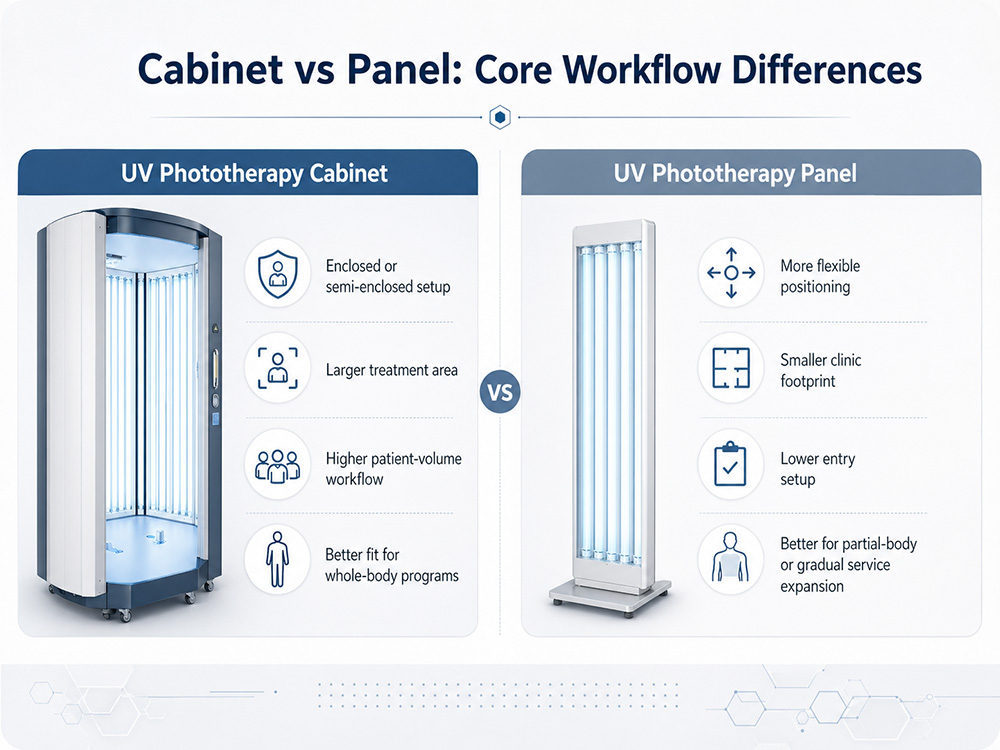
A UV phototherapy cabinet and a phototherapy panel may both deliver therapeutic ultraviolet light, but they are built for different use environments. A cabinet is usually associated with a more structured, whole-body or large-area treatment workflow. A panel is often more flexible, more space-conscious, and easier for clinics that are building phototherapy services gradually.
This distinction matters for two groups. For clinics, it affects patient scheduling, treatment consistency, space planning, staff workflow, and long-term service capacity. For distributors, it affects customer positioning. A cabinet should not be sold simply as “better” because it is larger. A panel should not be sold simply as “cheaper” because it is smaller. The stronger sales and clinical explanation is workflow-based.
What Is the Difference Between a Cabinet and a Panel?
A UV phototherapy cabinet is designed for more structured exposure. In whole-body or large-area programs, the patient usually stands inside or in front of an enclosed or semi-enclosed treatment area while multiple lamps deliver UV exposure from different directions. DermNet describes UVB phototherapy as being delivered within a specially designed cabinet, with fluorescent tubes positioned to target affected areas, and full-body treatment requiring eye or face protection and appropriate covering of sensitive areas.
A UVB phototherapy panel is usually more open and flexible. It may support partial-body treatment, adjustable positioning, or smaller clinic spaces where a full cabinet is not necessary. KernelMed’s panel category includes multiple configurations, including whole-body half-cabin and panel-style systems, while the cabinet category is more clearly positioned around larger cabinet systems such as KN-4001 and KN-4005.
The real difference is therefore not only physical size. It is the treatment model: structured whole-body workflow versus flexible or staged phototherapy setup.
When a UV Phototherapy Cabinet May Be the Better Fit
A UV phototherapy cabinet may be the better fit when a clinic needs a more structured whole-body treatment setup. This is especially relevant for dermatology departments, hospital-based phototherapy units, and higher-volume clinics that regularly manage patients requiring broader exposure programs.
Cabinets can make sense when the clinic sees enough psoriasis, vitiligo, eczema, or other phototherapy-appropriate cases to justify a dedicated treatment space. They may also be more suitable when treatment programs require consistent large-area exposure and a more standardized patient flow. KernelMed’s KN-4001 cabinet is positioned around 40 pieces of 100W UV lamps, with PUVA and NB-UVB output that can work separately or simultaneously. The KN-4005 cabinet is positioned with 26 UV lamps, UVA / UVB / UVA+UVB combinations, touch-screen operation, case management, and optional real-time UV intensity display.
The point is not that a cabinet is automatically superior. The point is that it fits a clinic that already has the space, staff routine, and patient demand for more structured whole-body phototherapy.
When a Phototherapy Panel May Be Enough
A UVB phototherapy panel may be enough when the clinic needs flexibility, lower installation burden, or partial-body treatment support. This can include smaller dermatology clinics, budget-conscious buyers, or practices that want to start with UV treatment but do not yet need a full cabinet workflow.
A panel can also be useful when treatment areas are more limited or when positioning flexibility matters. KernelMed's panel category includes devices such as the KN-4004A/B/AB whole-body half-cabin UV phototherapy panel, which uses 8 Philips UV lights, includes touch-screen operation, supports PUVA and NB-UVB separately or simultaneously, and includes case management function.
For some clinics, that type of setup may be more realistic than a full cabinet. It allows them to offer clinical UV phototherapy without committing immediately to a larger footprint or higher-volume service model.
What Clinics Should Evaluate Before Choosing a Setup
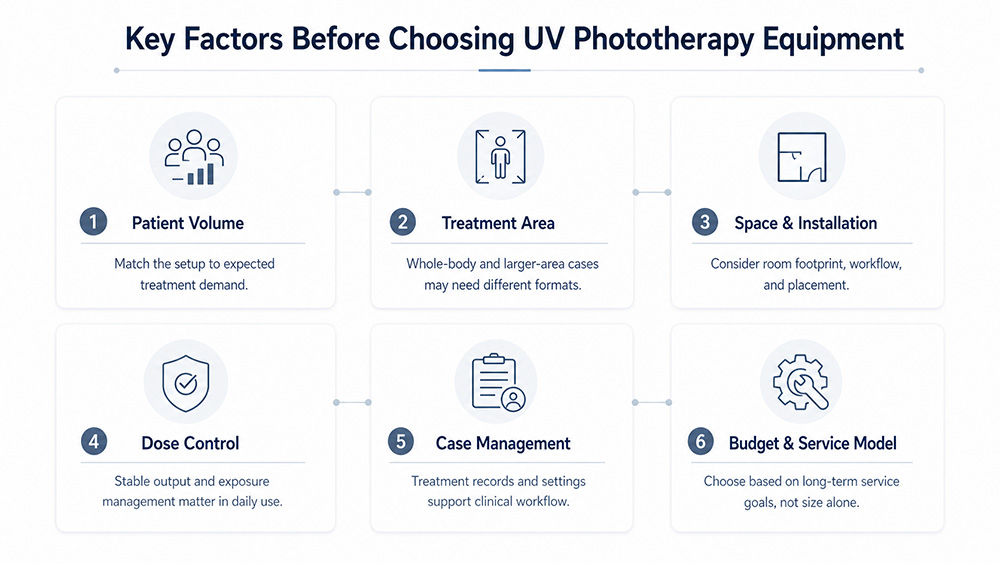
The first question is patient volume. A clinic that treats only occasional phototherapy cases may not need a cabinet. A clinic with steady whole-body psoriasis or vitiligo phototherapy demand may benefit from a more structured cabinet setup.
The second question is treatment area. Generalized disease, broader body involvement, or repeated whole-body treatment programs may favor cabinet-style systems. Localized or partial-body needs may be handled with panels, targeted systems, or smaller units depending on the case.
The third question is space. A cabinet usually requires a dedicated treatment area and a more fixed clinic workflow. A panel may be easier to place, move, or integrate into a smaller room.
The fourth question is dose control and monitoring. In phototherapy, dose logic matters. The BAD/BPG guidelines address practical NB-UVB use in clinic and home settings, while patient preparation materials emphasize that treatment time and dose depend on irradiance and manufacturer instructions. That makes features such as case management, intensity monitoring, and stable lamp output more than marketing details.
The fifth question is service model. A clinic planning to become a phototherapy center may think differently from a clinic adding UV treatment as one option among many. Equipment selection should follow the service model, not the other way around.
What This Means for Distributors
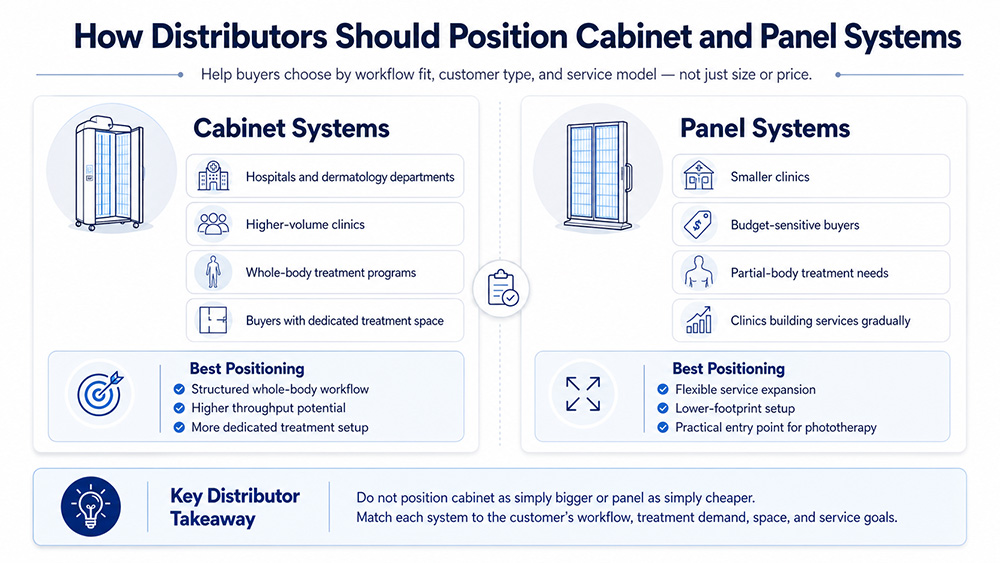
For distributors, this comparison is commercially important. Cabinet systems are not only larger machines; they are better positioned for customers who already understand phototherapy workflow or have higher patient volume. Suitable customers may include dermatology departments, hospital outpatient units, clinic chains, and higher-volume dermatology centers.
Panel systems may be easier to position for smaller clinics, new phototherapy buyers, or customers who need flexibility. They may also work better in markets where clinics are cautious about space, budget, or service volume.
The key is to avoid lazy positioning. “Cabinet is more professional” is too vague. “Panel is cheaper” is too weak. A stronger distributor message is:
cabinet for structured whole-body and higher-throughput workflows
panel for flexible, lower-footprint, or staged phototherapy service development
That message is more credible because it helps the buyer solve a practical problem.
Choosing Based on Workflow, Not Size Alone
A common mistake is to compare cabinet and panel systems only by size, lamp count, or price. Those details matter, but they do not answer the real question: how will the equipment be used every week?
A cabinet may be the better choice when the clinic needs consistent whole-body exposure, higher throughput, and a dedicated treatment process. A panel may be the better choice when the clinic needs flexibility, lower installation burden, or partial-body support. Neither format is automatically right for every clinic.
The right setup is the one that fits patient flow, clinical indication mix, staff routine, treatment room conditions, and long-term service plans.
Conclusion
UV phototherapy cabinets and panels both have a place in dermatology practice, but they serve different clinic and distributor needs. A cabinet is better aligned with structured whole-body treatment and higher-volume workflows. A panel may be more suitable for smaller clinics, flexible treatment needs, or buyers building a phototherapy service gradually.
For clinics, the decision should be based on patients, workflow, space, and dose management. For distributors, the strongest positioning is not to oversell one format, but to match the right system to the right customer.
Explore KernelMed's UV phototherapy solutions for cabinet, panel, targeted, and home-use treatment workflows.
FAQ
What is the main difference between a UV phototherapy cabinet and a panel?
A cabinet is usually designed for more structured whole-body or large-area treatment, while a panel offers more flexible positioning and may better fit smaller clinics or partial-body treatment needs.
Is a UV phototherapy cabinet always better than a panel?
No. A cabinet may be better for high-volume whole-body workflows, but a panel may be more practical for smaller clinics, lower patient volume, or flexible treatment setups.
Which setup is better for whole-body NB-UVB phototherapy?
A cabinet is usually better aligned with structured whole-body NB-UVB treatment because it provides a more dedicated treatment environment.
What should clinics evaluate before buying a phototherapy cabinet?
Clinics should evaluate patient volume, treatment area, room space, dose control, lamp configuration, case management, staff workflow, and long-term service demand.
Can distributors sell both cabinet and panel systems to different customers?
Yes. Cabinets are better positioned for higher-volume dermatology departments or clinics with structured phototherapy programs. Panels may fit smaller clinics, flexible service models, or buyers starting phototherapy services gradually.
References
[1] British Association of Dermatologists and British Photodermatology Group. Guidelines for Narrowband Ultraviolet B Phototherapy 2022.
Source: BAD/BPG guidelines.
[2] DermNet. UVB Phototherapy.
Source: DermNet clinical education page.
[3] American Academy of Dermatology. Psoriasis Clinical Guideline / Phototherapy Information.
Source: AAD guideline and patient education resources.
[4] KernelMed. UV Phototherapy Cabinet Category.
Source: KernelMed product category page.
[5] KernelMed. KN-4001 UV Phototherapy Cabinet System for Vitiligo and Psoriasis.
Source: KernelMed product page.
[6] KernelMed. Narrow Band UVB Phototherapy Cabinet KN-4005.
Source: KernelMed product page.
[7] KernelMed. UV Phototherapy Panel Category and KN-4004A/B/AB Product Page.
Source: KernelMed product pages.