



How to Achieve Near-Complete Repigmentation with Home NB-UVB: The Standard Protocol
2026-02-25 16:241. Summary
This comprehensive guide outlines the clinical standards for administering 311nm Narrowband UVB (NB-UVB) therapy in a home setting. By adhering to the Kernel Graduated Increment Protocol, patients can safely manage chronic skin conditions such as vitiligo and psoriasis. This document details the biological mechanisms of localized repigmentation and provides a roadmap to achieving near-complete pigment restoration through evidence-based dosing and safety measures.
2. Introduction: The Science of 311nm
Narrowband UVB (311nm) is the globally recognized gold standard for non-ionizing radiation therapy. Unlike broad-spectrum UV, the 311nm wavelength targets the epidermis to induce the apoptosis of T-cells and stimulate dormant melanocyte stem cells.
3. Pre-Treatment: Safety and Skin Preparation
Precision begins with preparation. To ensure maximum photon absorption and ocular safety:
Ocular Protection: Users must wear UV-opaque goggles at all times. Eyelids do not filter 311nm radiation effectively.
Skin Cleansing: Remove all barriers (creams, scales, or perfumes) that could reflect or scatter UV light.
Fitzpatrick Typing: Identify your skin type (I-VI) to determine your initial "Erythematogenic Threshold."
4. The Clinical Protocol: The "10-20% Rule"
Consistency and incremental dosing are the pillars of successful home phototherapy.
4.1 Frequency
A schedule of 3 sessions per week (e.g., Mon/Wed/Fri) is optimal. This allows a 48-hour refractory period for DNA repair and melanin synthesis.
4.2 Dose Adjustment Algorithm
Initial Dose: Start with 20-30 seconds (for most Kernel devices) to test sensitivity.
The Increment: If no redness occurs within 24 hours, increase the next dose by 10% to 20%.
The Sweet Spot: The goal is minimal asymptomatic erythema—a faint pink tint that indicates the biological threshold has been reached.
5. Evaluation: Monitoring the Repigmentation Journey
Phototherapy is a progressive physiological transformation.
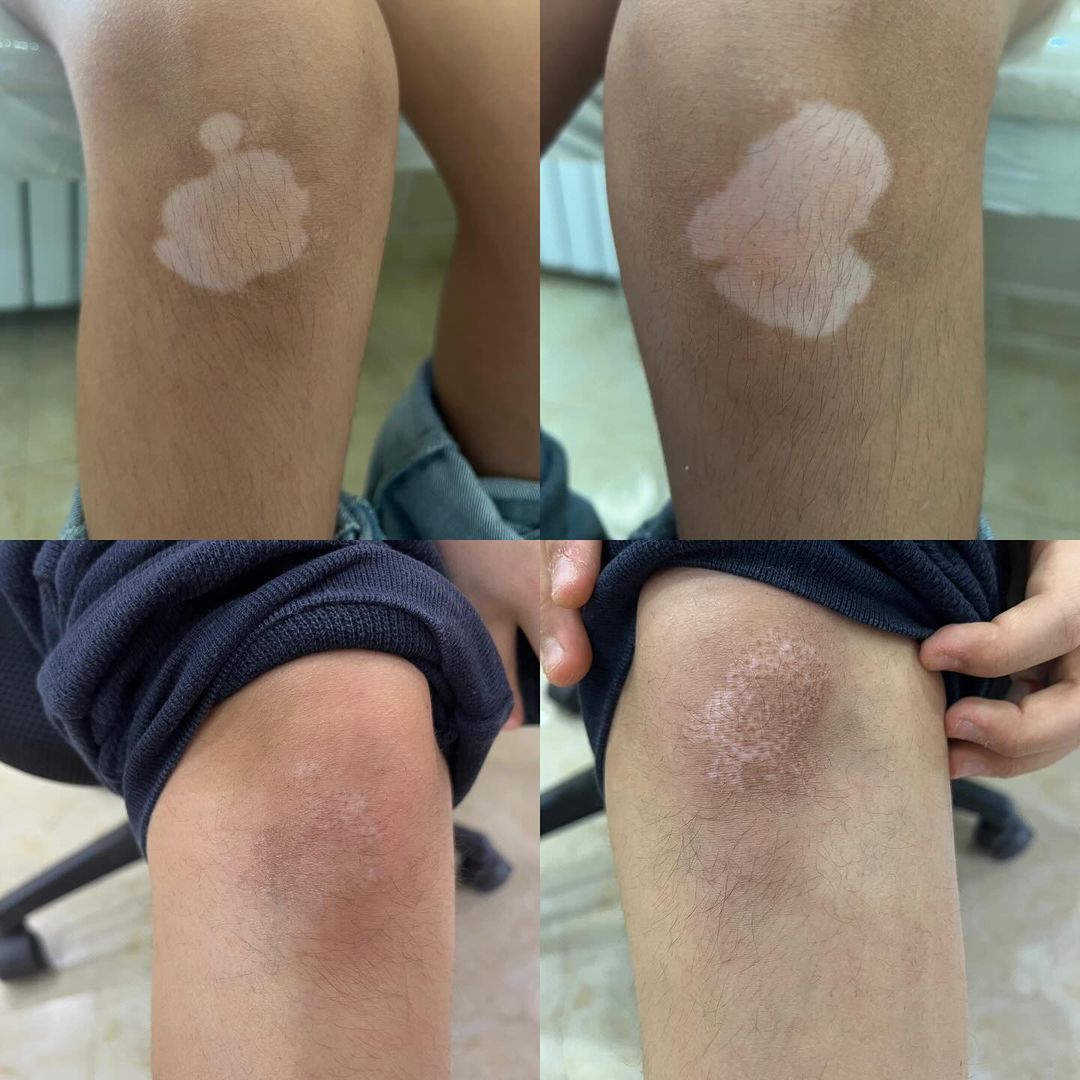
5.1 Localized Repigmentation (4-8 Weeks)
Early success typically manifests as perifollicular repigmentation (pigment islands appearing around hair follicles). This confirms the activation of the melanocyte reservoir.
5.2 Coalescence (3-5 Months)
Localized spots begin to merge. During this phase, strict adherence to the protocol is vital to prevent "stagnation."
5.3 Near-Complete Restoration (6 Months+)
Substantial restoration (>90%) is often achieved on the face and trunk within 6 months. Acral areas (hands/feet) may require a more prolonged, intensified protocol.
6. Safety and Side Effect Management
As a medical-grade manufacturer, Kernel Medical prioritizes risk mitigation.
Xerosis (Dryness): Apply fragrance-free emollients post-treatment to restore the lipid barrier.
Overexposure: If painful redness occurs, suspend treatment and resume at 50% of the previous dose once healed.
Contraindications: Do not use if you have a history of BCC, melanoma, or photosensitive disorders like Lupus.
7. Expert FAQ
Q: Can I use UVB every day?
A: No. Daily use increases the risk of cumulative burning without accelerating repigmentation. The 48-hour gap is biologically necessary.
Q: Will the results be permanent?
A: Maintenance therapy is often required. Once near-complete restoration is achieved, frequency can be reduced to once a week to stabilize the pigment.
Q: How do I handle "recalcitrant" zones like elbows?
A: These areas have fewer hair follicles. They may require higher localized doses or combination therapy with topical calcineurin inhibitors.
8. Conclusion
Home phototherapy with 311nm NB-UVB offers a bridge between clinical efficacy and patient convenience. By following a structured, data-driven protocol, substantial clinical improvement is an achievable reality for most patients.