



Where Pelvic Floor Magnetic Stimulation Fits in Conservative Care: A Practical Guide for Clinics and Distributors
2026-04-22 16:09Where Pelvic Floor Magnetic Stimulation Fits in Conservative Care: A Practical Guide for Clinics and Distributors
Pelvic floor magnetic stimulation is attracting more attention in women’s health, rehabilitation, and bladder control care, but it is often described too loosely. In practice, the more useful question is not whether the technology sounds innovative. The better question is where it fits in conservative care, which patients may benefit most, and what kind of clinic workflow can support it responsibly.
That matters because first-line care has not changed. NICE continues to recommend supervised pelvic floor muscle training for at least 3 months as first-line treatment for women with stress or mixed urinary incontinence, and its broader pelvic floor dysfunction guidance remains centered on assessment, non-surgical management, and symptom-specific care rather than quick device substitution.[1][2] For many clinics and distributors, the real question is not whether pelvic floor magnetic stimulation sounds promising, but where it fits after first-line conservative care.
Why This Topic Matters to Both Clinics and Distributors
For clinics, the decision is practical. Does this modality solve a real problem in daily care? That may include patients who struggle to perform an effective pelvic floor contraction, patients who are poorly adherent to exercise-based programmes, or patients who prefer a noninvasive clinic-based option over internal devices.
For distributors, the question is different but related. Does this product line have a clear, believable place in the market? A product becomes difficult to position when it is explained too broadly. If it is described as a universal answer for urinary incontinence, the message quickly becomes weak. If it is positioned as a noninvasive adjunct within conservative pelvic floor management, the value proposition becomes more realistic and easier to explain.
That more cautious positioning is also closer to the evidence. A 2025 systematic review and meta-analysis reported considerable evidence supporting extracorporeal magnetic stimulation for urinary incontinence, but also emphasized the need for more high-quality long-term studies. A 2025 systematic review focused on chair-based magnetic pelvic floor stimulation found improvement in continence and sexual function outcomes in the available open-access studies, but the evidence base was still small.
What Pelvic Floor Magnetic Stimulation Actually Adds
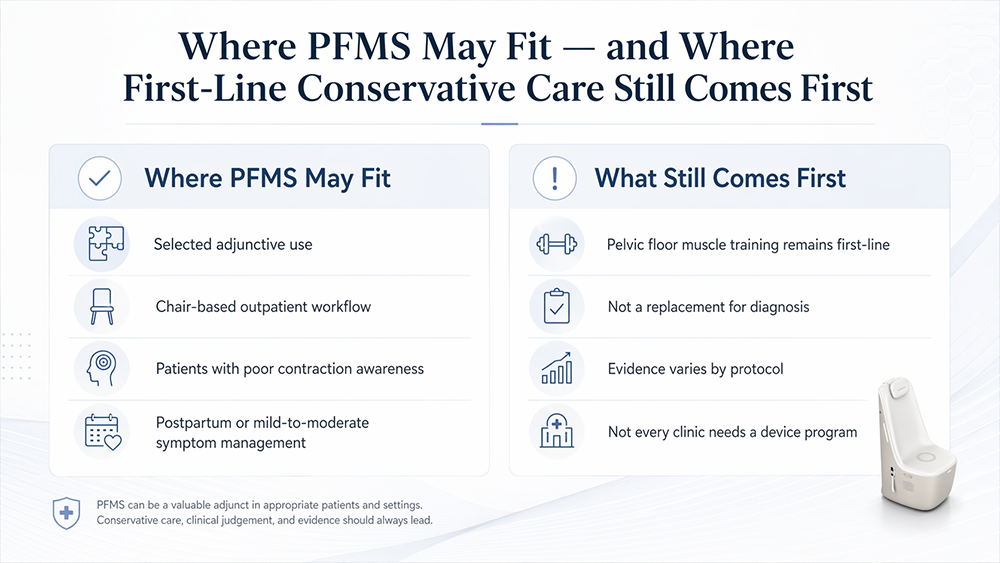
The practical appeal of pelvic floor magnetic stimulation is straightforward. It offers a noninvasive, chair-based treatment approach that may help activate pelvic floor muscles without internal probes. That can matter in real outpatient settings, especially for patients who have difficulty engaging with conventional pelvic floor exercises or who are reluctant to use internal treatment methods.
But the point is not that it replaces conservative care. The point is that it may broaden conservative care. In a clinic that already evaluates urinary incontinence, postpartum pelvic weakness, bladder dysfunction, or selected pelvic floor complaints, a chair-based modality may make it easier to offer an additional option when exercise-based care alone is not working well enough or is difficult to deliver consistently.
That is the strongest version of the argument, because it is practical rather than promotional. It treats the modality as a workflow addition, not as a shortcut around diagnosis, training, or follow-up.
Where It May Be a Good Fit
Pelvic floor magnetic stimulation may be a reasonable fit in clinics that already manage urinary incontinence, postpartum pelvic rehabilitation, or selected pelvic floor dysfunction cases and want a noninvasive adjunct that can be delivered in an outpatient format. It may be especially relevant for patients who struggle with effective muscle awareness, prefer a lower-barrier treatment experience, or are looking for a clinic-based option that does not depend entirely on home exercise adherence.
That does not mean every patient needs it. NICE still anchors first-line care in supervised pelvic floor muscle training for stress or mixed urinary incontinence, and related conservative pathways still include bladder training, assessment, and symptom-guided follow-up.[1][2] The more defensible position is that pelvic floor magnetic stimulation may complement conservative care in selected patients rather than replace it.
Recent reviews support exactly that more limited conclusion. The literature points to symptom improvement potential, but it also shows heterogeneity across protocols, endpoints, and follow-up periods. That is why this product line is easier to justify when the clinic already has a structured conservative pathway and is looking to expand options within it.
Where It May Be Less Convincing
This modality becomes harder to justify when a clinic does not already have a clear pelvic floor or continence workflow. If there is no structured intake, no symptom tracking, no follow-up plan, and no practical distinction between patient groups, the device may become difficult to use well no matter how attractive its noninvasive positioning sounds.
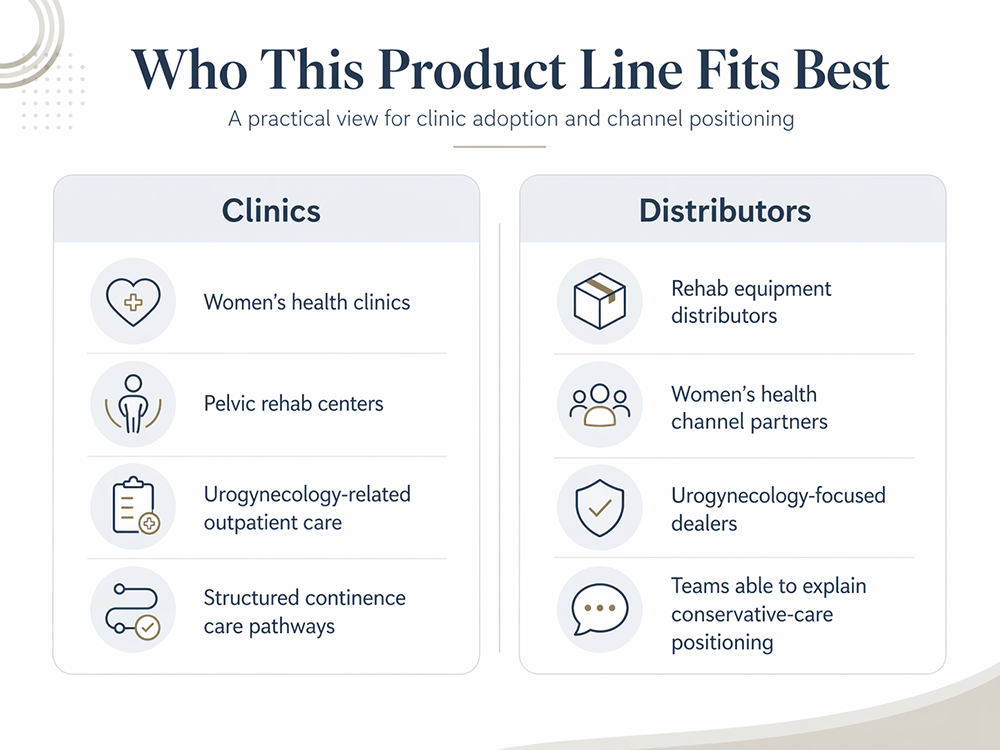
The same logic applies to distributors. A distributor without a women’s health, rehabilitation, urogynecology, or bladder-control customer base may struggle to position this category credibly. The strongest channel fit is usually with partners already selling into rehabilitation, physiotherapy, urogynecology, postpartum recovery, or continence-related service settings. In those environments, the device can be explained as part of a broader conservative care pathway instead of being forced into a generic wellness message.
The evidence also supports caution. A 2021 systematic review in Medicina noted that magnetic stimulation had been proposed for urinary incontinence but also summarized earlier reviews that found weak evidence for short- and long-term effects and referenced European guidance advising against routine use for urinary incontinence or overactive bladder at that time. That does not erase newer positive studies, but it is exactly why responsible positioning matters.
What Clinics and Distributors Should Evaluate Before Adding It
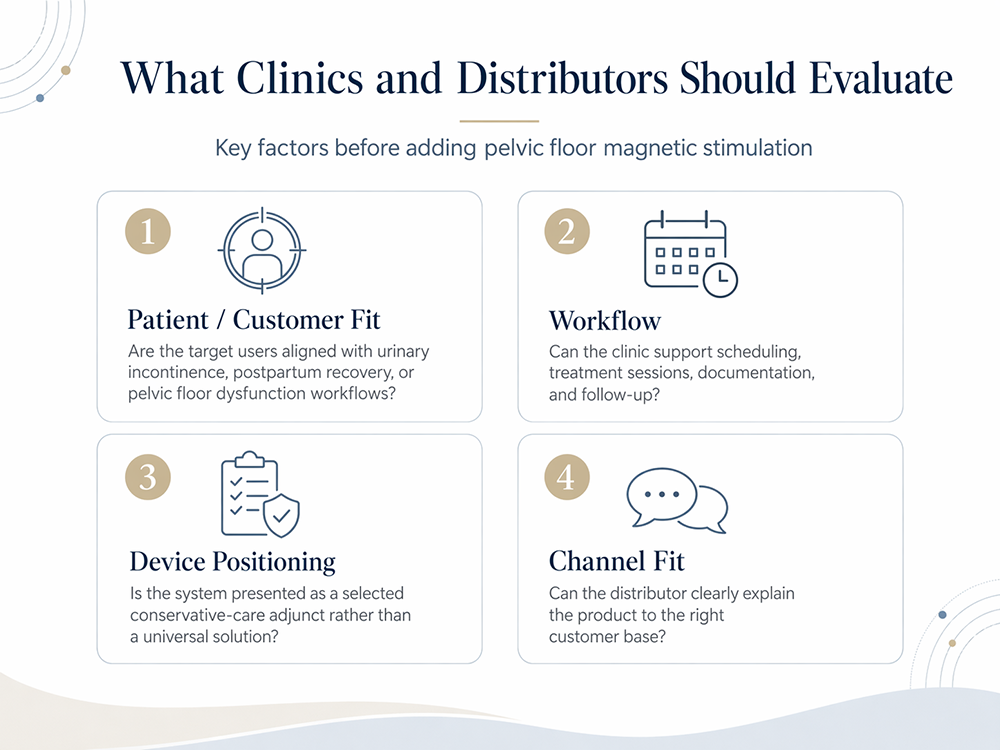
The first question is patient or customer fit. Clinics should ask whether they regularly see urinary incontinence, postpartum pelvic weakness, pelvic floor dysfunction, or bladder control cases for which a noninvasive adjunct is realistically useful. Distributors should ask whether their customers already serve those patient groups and whether they can explain the device within a conservative care model.
The second question is workflow. For buyers evaluating available pelvic floor magnetic therapy systems, workflow fit matters more than broad claims about comfort or intensity alone. A chair-based therapy programme only works if the clinic can schedule sessions, document response, and follow patients in a structured way. A distributor also needs to understand that workflow, because that is what determines whether the product becomes part of routine service rather than a showroom device.
The third question is device positioning. A clinic-level device such as a medical-grade pelvic floor magnetic stimulation system is better understood as a workflow tool for selected outpatient rehabilitation rather than a universal answer for every pelvic floor complaint. Your current product positioning already leans in that direction, emphasizing urinary incontinence, bladder dysfunction, postpartum recovery, preset programmes, and clinic-oriented use rather than vague lifestyle promises.
The fourth question is messaging. Clinics do not need exaggerated claims; they need a realistic picture of where the device fits. Distributors need the same thing. The strongest message is usually not “this changes everything.” It is “this may be useful for selected patients within conservative pelvic floor management when clinics want a noninvasive adjunct and have the workflow to support it.”
Choosing Based on Real Use, Not Hype
This category is easy to overstate. Words like noninvasive, comfortable, and chair-based sound attractive, but those words alone do not create a strong product line. What makes the category credible is practical use: which patients it helps, which clinics are most likely to use it well, and which distributors can position it without overselling it.
That is why the best commercial and clinical positioning meet in the same place. Clinics need a device that fits real care pathways. Distributors need a product that can be explained clearly to the right customers. In both cases, the stronger strategy is to position pelvic floor magnetic stimulation as a selected addition to conservative care rather than as a replacement for first-line management.
Conclusion
Pelvic floor magnetic stimulation can make sense in conservative care, but only when it is matched to the right patients, the right clinics, and the right commercial positioning. For clinics, it may be useful as a noninvasive adjunct for selected urinary incontinence, postpartum rehabilitation, and pelvic floor dysfunction workflows. For distributors, it is most credible when positioned for women’s health, rehabilitation, urogynecology, and continence-related service settings rather than as a catch-all wellness device.
Explore KernelMed's pelvic floor magnetic therapy solutions for urinary incontinence, postpartum rehabilitation, and clinic-based pelvic floor care.
FAQ
Is pelvic floor magnetic stimulation first-line treatment for urinary incontinence?
No. NICE still recommends supervised pelvic floor muscle training as first-line treatment for women with stress or mixed urinary incontinence.
Can pelvic floor magnetic stimulation replace pelvic floor muscle training?
It is better understood as a selected adjunct within conservative care rather than a universal replacement. Recent reviews show promising results, but evidence remains heterogeneous.
Which clinics are most likely to use this type of device well?
Clinics already managing urinary incontinence, postpartum pelvic rehabilitation, bladder dysfunction, or pelvic floor complaints within a structured outpatient pathway are more likely to integrate it effectively. This is an inference based on the modality’s chair-based clinic workflow and on how conservative care is structured in guidance and published studies.
Which distributors are the best fit for this product line?
Distributors already serving women’s health, rehabilitation, physiotherapy, urogynecology, or continence-related clinics are usually better placed to position it credibly. This is an editorial inference based on the product’s clinical fit and current category positioning, including KernelMed’s own product descriptions.
What should buyers evaluate before adding pelvic floor magnetic stimulation?
Patient mix, clinic workflow, scheduling, follow-up process, device usability, and how the modality fits alongside first-line conservative care are all more important than broad marketing claims.
References
[1] NICE. Urinary incontinence and pelvic organ prolapse in women: management.
Available at: https://www.nice.org.uk/guidance/ng123/chapter/recommendations
[2] NICE. Pelvic floor dysfunction: prevention and non-surgical management.
Available at: https://www.nice.org.uk/guidance/ng210
[3] Yang Z, et al. Effectiveness of Extracorporeal Magnetic Stimulation in the Treatment of Pelvic Floor Dysfunction: A Systematic Review and Meta-Analysis.
Available at: https://pubmed.ncbi.nlm.nih.gov/40401438/
[4] Sacarin G, et al. Chair-Based Magnetic Pelvic Floor Stimulation and Female Urinary Incontinence: A Systematic Review.
Available at: https://pmc.ncbi.nlm.nih.gov/articles/PMC12693354/
[5] Cai S, et al. Effects of Functional Magnetic Stimulation Combined With Pelvic Floor Muscle Training...
Available at: https://pmc.ncbi.nlm.nih.gov/articles/PMC12640596/
[6] Lukanović D, et al. Effectiveness of Magnetic Stimulation in the Treatment of Urinary Incontinence: A Systematic Review.
Available at: https://pmc.ncbi.nlm.nih.gov/articles/PMC8584787/
[7] KernelMed. Site Map / Pelvic Floor Magnetic Therapy product line.
Available at: https://www.kernelmedint.com/sitemap