



How to Evaluate a Laser Hair Growth System Beyond Wavelength and Diode Count
2026-05-13 17:15How Clinics and Distributors Should Evaluate a Laser Hair Growth System Beyond Wavelength and Diode Count
Laser hair growth devices are often compared by wavelength, diode count, treatment time, or whether a product is described as FDA-cleared. Those details matter, but they do not answer the more practical question: will this system fit the clinic’s treatment workflow, the patient’s ability to use it consistently, and the distributor’s real customer base?
That question matters because low-level laser therapy, also called LLLT or photobiomodulation, is not a miracle cure for every type of hair loss. It is generally discussed as a noninvasive option for selected hair loss workflows, especially androgenetic alopecia, and it requires consistent use over time. For clinics and distributors, the practical question is how to evaluate a laser hair growth system as part of a real treatment workflow rather than as a simple parameter comparison.
Why Wavelength and Diode Count Are Not Enough
Wavelength and diode count are visible, easy-to-compare numbers, which is why many consumer and competitor pages focus on them. Current market comparisons often highlight numbers such as diode count, laser versus LED mix, treatment time, and red-light wavelength ranges. For example, competitor comparison pages and reviews frequently compare products by 655 nm or 650 nm wavelength, 120 to 500 diodes, and session times from several minutes to around half an hour.
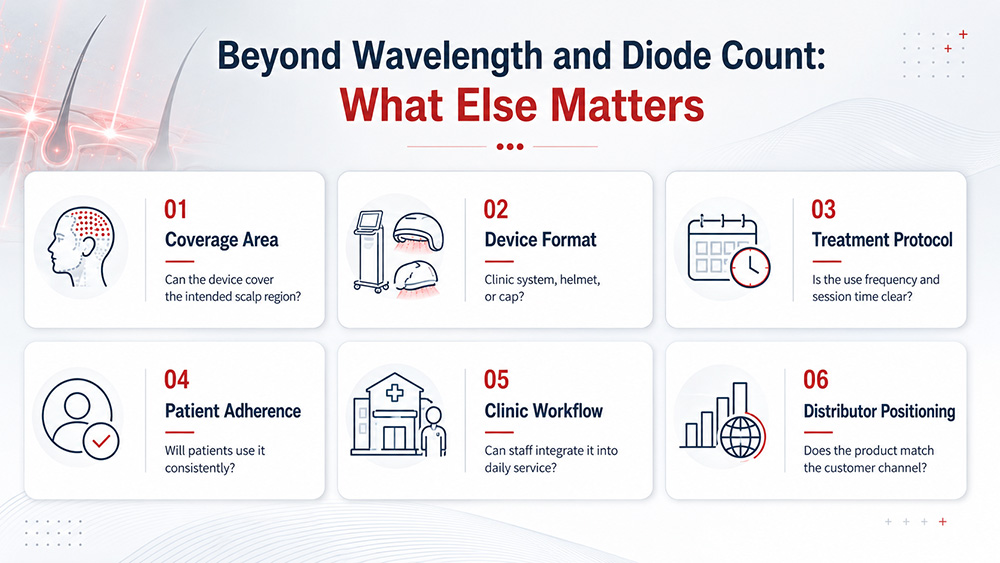
But clinic buyers and distributors need to go beyond that. A device with more diodes is not automatically better if it does not cover the target scalp area well, is uncomfortable to use, lacks a repeatable protocol, or does not match the customer’s service model. A product with a commonly used red-light wavelength is not automatically suitable for every hair loss workflow either.
The stronger question is: does the device deliver a practical treatment experience that patients can actually follow and clinics can actually support?
What LLLT Actually Adds in Hair Loss Workflows
LLLT has been studied mainly as a noninvasive treatment option for androgenetic alopecia. Reviews describe LLLT as a modality that may stimulate hair growth in men and women with androgenetic alopecia, while also noting that clinical protocols, device designs, and study quality vary. A 2021 review in Journal of Cutaneous and Aesthetic Surgery reported that LLLT has been used for androgenetic alopecia and described FDA clearance history for hair growth devices, while a systematic review and meta-analysis of randomized trials found that LLLT increased hair density compared with sham treatment.
That does not mean it should be positioned as a replacement for diagnosis, medication, hair transplantation, or medical evaluation. The American Academy of Dermatology lists laser therapy as an option that may help hereditary hair loss, alopecia areata, chemotherapy-related hair loss, and healing after hair transplantation, but it is still presented as one option within broader hair loss care rather than a universal answer.
For a broader clinical evidence review, KernelMed has already covered low-level laser therapy for hair regrowth in detail, so this article focuses more on buyer evaluation and workflow fit.
Device Format Matters: Clinic System, Helmet, or Cap?
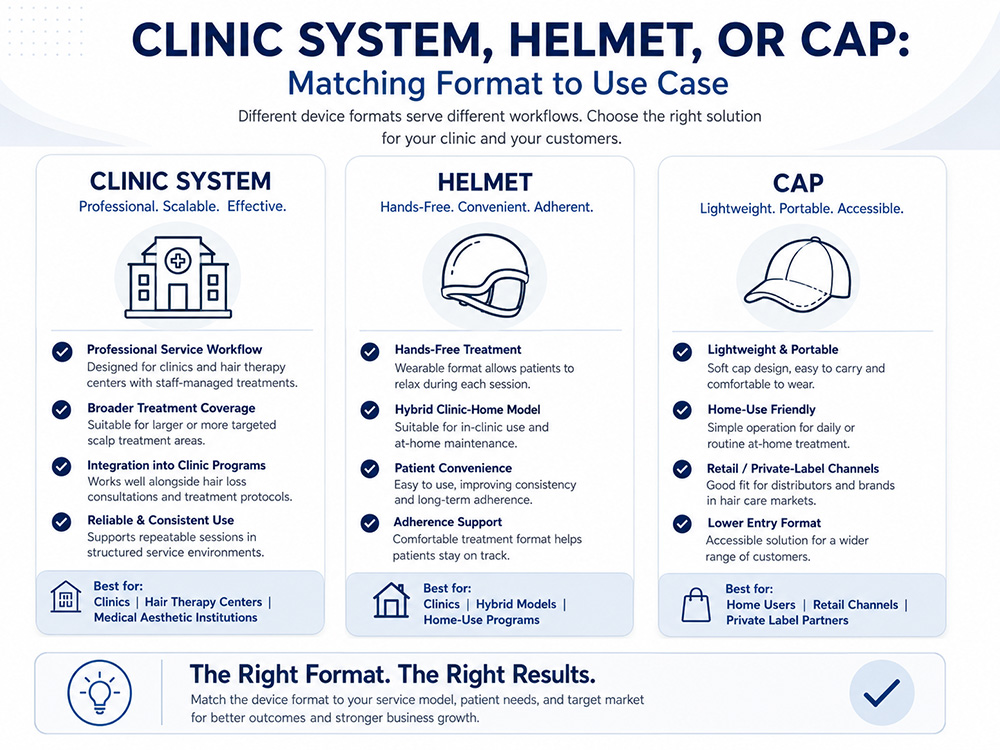
A clinical laser hair growth system, helmet, and cap may all use LLLT-related principles, but they are not the same product type. They serve different use cases.
A clinic system is usually better suited to professional service environments where staff can manage sessions, position the treatment head, guide patient expectations, and integrate the device into a hair loss or scalp therapy program. KernelMed’s KN-8000A product page positions it as a professional 650 nm low-level laser hair growth therapy system for noninvasive scalp treatment and hair regrowth support in dermatology, medical aesthetics, and professional hair care settings.
A laser hair growth helmet such as KN-8000B may be easier to position when the buyer needs hands-free use, patient convenience, Bluetooth/app operation, and hybrid clinic-home adoption. KernelMed’s KN-8000B page lists 204 medical-grade semiconductor laser diodes, Bluetooth function, app operation, and suitability for dermatology clinics, hair loss therapy centers, beauty salons, and personal home use.
A cap format can be more portable and home-use friendly. KernelMed’s KN-8000C page lists 80 medical-grade semiconductor laser diodes and 30 LEDs, low-energy laser irradiation, helmet-style design, and partition irradiation technology for different levels of hair loss.
For distributors, this is important. The right product is not always the one with the highest specification. The right product is the one that matches the customer’s actual sales channel and user scenario.
What Clinics Should Evaluate Before Choosing a Hair Growth System
The first factor is patient type. Laser hair growth systems are most often discussed in relation to androgenetic alopecia and hair thinning workflows. Clinics should avoid positioning the device as suitable for every cause of hair loss before diagnosis.
The second factor is treatment coverage. A device should cover the intended scalp area consistently. Crown thinning, diffuse thinning, frontal recession, and broader scalp coverage may require different format considerations.
The third factor is adherence. LLLT depends on repeated use over time. If the device is uncomfortable, inconvenient, too difficult to operate, or too hard to schedule, real-world outcomes may suffer. In consumer reviews and market comparisons, treatment time and ease of use are frequently emphasized because consistency matters in practice.
The fourth factor is protocol repeatability. Clinics need a setup that can be used consistently by staff and patients. Treatment duration, use frequency, device positioning, and follow-up expectations should be clear.
The fifth factor is device format. A clinic-based system may support professional service workflows, while a helmet or cap may support hybrid or home-use models. Clinics should choose based on the service they plan to offer, not simply on which model looks more advanced.
The sixth factor is expectation management. LLLT should be described as a supportive, noninvasive hair growth option for selected patients. It should not be presented as a guaranteed solution for all hair loss types.
What This Means for Distributors
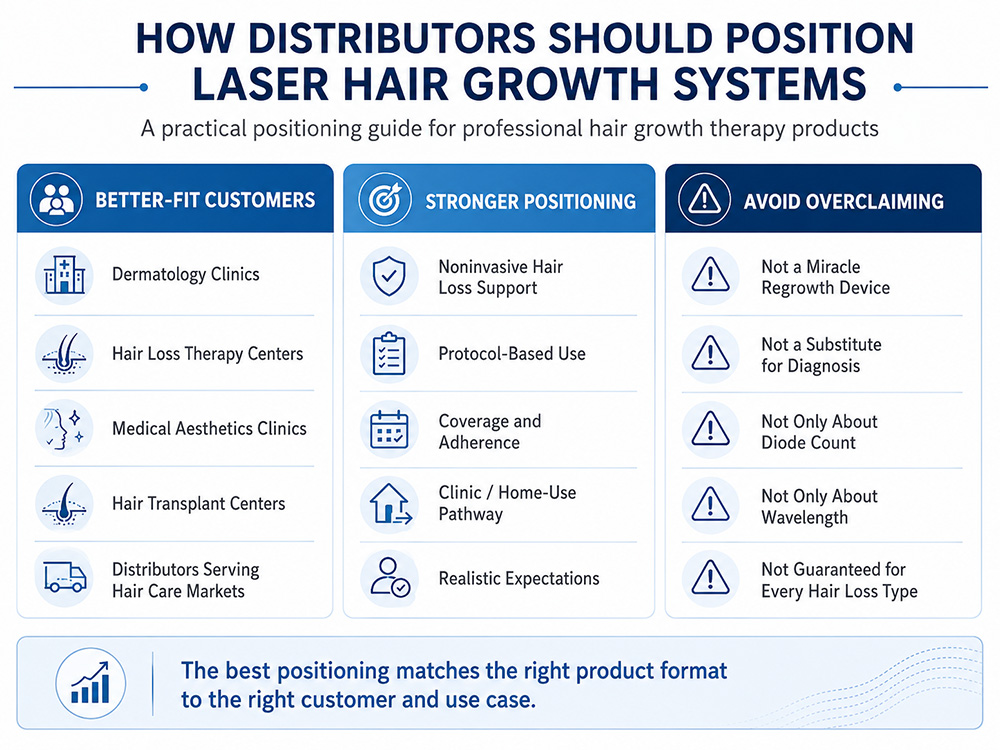
For distributors, the best sales strategy is not to lead with “more diodes” or “better wavelength” alone. Those points can support the conversation, but they should not be the entire positioning.
Better-fit customers may include dermatology clinics, hair loss therapy centers, medical aesthetics clinics, hair transplant clinics, professional hair care centers, and retail or private-label partners. But each customer type may need a different product format.
Clinic systems may be easier to position for professional treatment rooms and staff-managed services. Helmets may fit customers looking for hands-free use and hybrid clinic-home workflows. Caps may be suitable for lighter home-use or retail-oriented channels. KernelMed’s hair growth system category supports this broader product-line approach by listing professional systems, helmets, and cap formats together rather than presenting the category as a single device type.
Distributors should also avoid overclaiming. “Hair regrowth” messaging should be grounded in realistic expectations, especially because hair loss type, duration, age, adherence, medical history, and combination therapy can all affect outcomes.
Choosing Based on Workflow, Not Just Specs
A laser hair growth system should be evaluated as part of a workflow. That means asking practical questions.
Can the clinic identify suitable patients? Can staff explain the treatment clearly? Does the device format fit the room, service model, and expected session frequency? Will patients use it consistently? Does the distributor understand whether the buyer needs a clinic system, a helmet, a cap, or a mixed product portfolio?
These questions are more useful than asking only whether a device has 650 nm or 655 nm light, or whether one product has more diodes than another.
The strongest product positioning is not “more powerful” or “more advanced” in a vague way. It is: the right format for the right hair loss workflow, with realistic expectations and consistent use.
Conclusion
Laser hair growth systems can play a practical role in modern hair loss care, especially when clinics and distributors understand their real place in the workflow. Wavelength, diode count, and treatment time are useful specifications, but they are not enough to decide whether a system is right.
Clinics should evaluate patient type, treatment coverage, adherence, device format, workflow repeatability, and follow-up. Distributors should position the product line by customer type and use case rather than by specifications alone.
Explore KernelMed's hair growth systems for clinic-based therapy, helmet-style treatment, and portable cap formats.
FAQ
Is LLLT effective for hair growth?
LLLT has clinical evidence supporting its use in androgenetic alopecia, including randomized studies and systematic reviews, but outcomes depend on patient selection, device protocol, and consistent use. It should be positioned as a noninvasive supportive option, not a guaranteed cure.
What wavelength is commonly used for laser hair growth?
Many hair growth laser devices use red light around 650 nm to 655 nm, and some devices use combinations of lasers and LEDs. However, wavelength alone does not determine whether a device fits a clinic or distributor workflow.
Is diode count the most important factor?
No. Diode count is easy to compare, but treatment coverage, device fit, comfort, session consistency, protocol design, and real-world adherence are also important.
What is the difference between a clinic system and a laser hair growth helmet?
A clinic system is usually better for staff-managed professional workflows. A helmet is more suitable for hands-free use, hybrid clinic-home use, and patient convenience.
Who is the right customer for a professional laser hair growth system?
Better-fit customers may include dermatology clinics, medical aesthetics clinics, hair loss therapy centers, hair transplant clinics, and distributors serving professional hair care or scalp therapy markets.
References
[1] KernelMed. Hair Growth System product category.
[2] KernelMed. 650nm Low-Level Laser Hair Growth Therapy System KN-8000A.
[3] KernelMed. Laser Hair Growth Helmet KN-8000B.
[4] KernelMed. Laser Cap Hair Regrowth Therapy Helmet KN-8000C.
[5] KernelMed. Clinical Review of Low-Level Laser Therapy for Hair Regrowth.
[6] Pillai JK, et al. Role of Low-Level Light Therapy in Androgenetic Alopecia.
[7] Lueangarun S, et al. Systematic Review and Meta-analysis of Randomized Controlled Trials of LLLT in Androgenetic Alopecia.
[8] American Academy of Dermatology. Hair loss: Diagnosis and treatment.