



Why Spot Size Matters in 308nm Targeted Phototherapy
2026-06-24 16:01Why Spot Size Matters in Targeted 308nm Phototherapy: Precision, Coverage, and Treatment Time
A patient has one small vitiligo patch near the eye.
Another has twelve scattered lesions across the hands and forearms.
Both are prescribed targeted 308nm phototherapy.
Should they be treated with the same spot size?
At first glance, the answer may seem obvious. A smaller spot appears more precise. A larger spot appears faster.
But real treatment is rarely that simple.
A small treatment field can follow a lesion boundary closely, yet it may require repeated repositioning when several lesions must be covered. A larger field can reduce the number of placements, but it may be harder to match around a narrow, curved, or irregular lesion.
The most useful spot size is therefore not automatically the smallest or the largest.
It is the one that fits the lesion.
That depends on:
lesion size
lesion shape
number of lesions
anatomical location
surrounding healthy skin
treatment-head stability
prescribed dose
irradiance
repositioning time
treatment documentation
This is why two devices that both deliver 308nm light can create very different clinical workflows.
The wavelength may be the same. The treatment experience may not be.
One Wavelength, Two Very Different Treatment Workflows
Targeted phototherapy delivers ultraviolet radiation directly to selected skin lesions rather than exposing a large area of uninvolved skin.
That is its central advantage.
In localized vitiligo, psoriasis, and other selected conditions, the treatment head can be directed toward the affected area while surrounding skin is shielded or avoided.
However, the phrase “targeted treatment” does not describe one universal treatment field.
Different systems may use:
a fixed round spot
a rectangular treatment window
interchangeable masks
adjustable apertures
reduction tips
templates
a larger fixed irradiation area
The practical difference becomes obvious during treatment.
Imagine two patients:
Patient A: One 1 cm facial lesion
The main concern is following the lesion margin without repeatedly exposing the surrounding pigmented skin.
A smaller or adjustable treatment field may make sense.
Patient B: Several larger patches across the forearms
The challenge is no longer only boundary precision. It is also the number of placements, total session time, overlap control, and operator workload.
A very small spot may still be precise, but it may not be efficient.
This is why spot size should be viewed as a workflow parameter rather than a simple performance ranking.
What Spot Size Really Changes
Spot size describes the area illuminated during one placement of the treatment head.
It does not describe:
wavelength
irradiance
dose
fluence
treatment frequency
clinical efficacy
total treatment time by itself
These specifications are related, but they are not interchangeable.
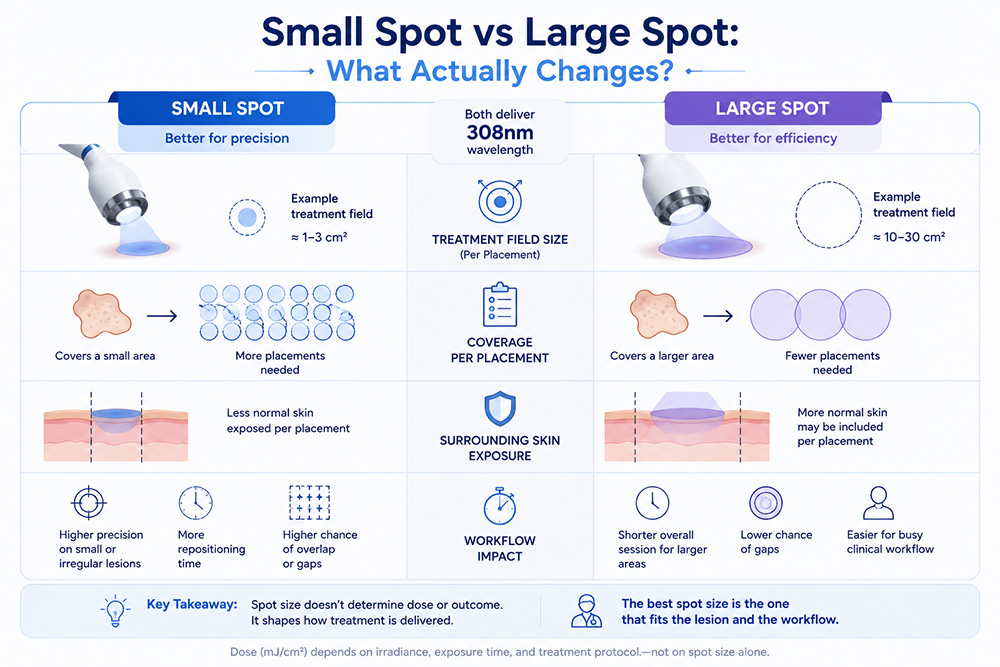
A larger treatment field covers more skin per placement.
A smaller treatment field covers less skin per placement.
That sounds basic, but the downstream effects are important.
Spot size can influence:
how closely the treatment field follows lesion borders
how many times the applicator must be moved
how easy it is to treat irregular shapes
how much normal skin may be included
how likely gaps or overlaps are
how long the operator spends repositioning
how easy the session is to document
how comfortable the patient remains during treatment
The spot size does not determine the dose delivered to each square centimetre. That depends on the device output and prescribed settings.
A larger treatment field is not automatically a higher dose.
A smaller field is not automatically safer.
The clinical value comes from matching field size to lesion geometry and treatment workflow.
When a Smaller Spot Helps
A smaller treatment spot can be useful when the lesion itself is small, narrow, isolated, or surrounded by a substantial amount of unaffected skin.
Typical examples may include:
a small facial vitiligo patch
a lesion close to the eye or hairline
a narrow border around the lips
a small lesion on a finger
an irregular residual patch after partial repigmentation
an isolated psoriasis plaque
a treatment area close to sensitive or unaffected skin
In these situations, a smaller field may help the operator follow the visible lesion more closely.
But 'smaller' should not be confused with 'automatically more accurate.'
Accuracy still depends on:
whether the treatment edge is clearly visible
whether the handpiece remains stable
whether the operator can reproduce the position
whether shielding or templates are used
whether the lesion border has been marked
whether the patient moves during treatment
whether the same area is accidentally exposed twice
A small spot used without a consistent movement pattern can still create uneven coverage.
For example, when treating a narrow curved lesion, the operator may need to rotate or reposition the treatment head several times. Each movement creates another opportunity for overlap or a missed area.
The smaller field improves control only when the workflow also supports control.
When a Larger Spot Can Save More Than Time
A larger treatment field is often discussed only as a way to shorten treatment time.
That is part of the story, but not the whole story.
A larger spot can also reduce:
the number of handpiece placements
the number of alignment decisions
the chance of leaving untreated gaps
the amount of time the patient must hold still
the operator’s repetitive movement
the complexity of documenting treated areas
This may be useful for:
larger localized vitiligo patches
several adjacent lesions
medium-sized psoriasis plaques
broad but still localized treatment regions
busy outpatient workflows
patients who find prolonged positioning difficult
Consider a rectangular lesion measuring 5 cm by 6 cm.
A device with a small treatment window may require many separate placements to cover the area.
A larger treatment field may cover it in one or a few placements.
The light delivery time per placement may not change dramatically, but the total session can still become shorter because less time is spent moving, aligning, checking, and documenting the handpiece.
This distinction matters.
Total treatment time includes more than the time the light is on.
It may include:
lesion inspection
positioning
shielding
alignment
exposure
repositioning
repeated exposure
treatment logging
patient movement between sites
A larger treatment area may reduce the non-exposure part of the session.
That can improve workflow even when the prescribed dose remains unchanged.
The Hidden Problem: Overlap, Gaps, and Repositioning
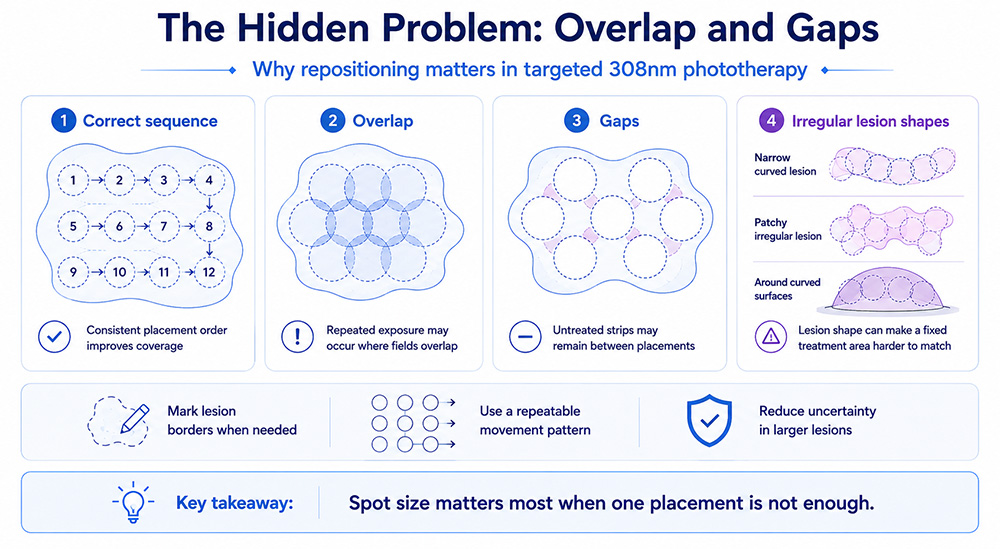
Spot size becomes most clinically interesting when the lesion cannot be covered in one placement.
At that point, the operator must tile the treatment field across the lesion.
This creates two common risks.
Overlap
If one treatment placement partially covers an area that was already treated, that region may receive repeated exposure.
The degree of extra exposure depends on:
how much the fields overlap
whether the same dose is delivered at each placement
how accurately the operator tracks the treated area
whether the lesion border is visible
whether a template or guide is used
Overlap does not automatically cause an adverse reaction, but uncontrolled overlap can make dose distribution less predictable.
Gaps
If each placement is spaced too far apart, small strips of the lesion may receive little or no treatment.
The final pattern can resemble tiles with narrow untreated lines between them.
This may be more likely when:
the spot is small
the lesion is large
the border is irregular
the treatment area is curved
the patient moves
many placements are required
the operator does not use a fixed sequence
Why a repeatable movement pattern matters
A practical approach is to treat the lesion in a consistent order.
For example:
left to right
top to bottom
centre outward
according to a marked grid
using numbered treatment zones
This sounds simple, but it makes the workflow more reproducible.
For larger or irregular lesions, clinics may also use:
lesion photographs
transparent templates
skin-safe border markings
treatment maps
standardized documentation
aperture masks
The goal is not to turn treatment into a complex geometric exercise.
It is to reduce uncertainty.
Irregular Lesions Change the Meaning of “Treatment Area”
A device specification may state that its treatment area is 3 cm², 16 cm², or 30 cm².
That number describes the maximum field generated by the equipment.
It does not mean every lesion of that size can be covered perfectly in one placement.
A 20 cm² lesion may be:
long and narrow
round
crescent-shaped
divided into separate islands
wrapped around a finger
positioned over a joint
partly repigmented
crossed by normal skin
The real match between spot size and lesion depends on shape as much as area.
A large rectangular field may suit a broad flat patch.
It may be less suitable for a narrow curved lesion unless masks or reduction tips are available.
Likewise, a smaller spot may fit a narrow lesion well but become inefficient when many adjacent areas must be treated.
This is why product specifications should be interpreted with lesion geometry in mind.
Anatomical Location Matters
A spot size that works well on the trunk may be awkward on the hands, face, scalp, elbows, or knees.
Face
Facial lesions may have narrow margins and lie close to the eyes, lips, nostrils, or hairline.
Precise positioning and shielding can be more important than maximum coverage.
Hands and feet
Acral areas contain multiple small surfaces, curves, fingers, toes, and bony contours.
A large flat field may not contact or align evenly across every surface.
A smaller or shaped aperture may be more practical.
Elbows and knees
These areas are curved and may move during treatment.
A stable handpiece and repeatable angle can matter as much as nominal spot size.
Scalp
Hair can block light and make lesion borders difficult to see.
A smaller treatment field may help navigate localized areas, but repositioning and hair separation add time.
Trunk and limbs
Broader, flatter lesions may benefit more from a larger field, particularly when several adjacent placements would otherwise be required.
The correct question is therefore not:
What is the largest spot size available?
It is:
Can the treatment field be applied consistently to the body areas this clinic treats most often?
Why Spot Size Alone Cannot Predict Session Time
It is tempting to assume:
larger spot = faster treatment
Often, that may be directionally true.
But spot size alone cannot predict the total session duration.
Treatment time also depends on:
total lesion area
number of lesions
prescribed dose
device irradiance
exposure time per placement
movement between lesions
shielding requirements
patient positioning
operator experience
treatment records
equipment setup
Consider two examples.
Example 1: One larger lesion
A broad treatment field may cover the lesion in one placement and reduce repositioning.
Example 2: Ten small scattered lesions
A large field may still require ten separate placements because the lesions are not adjacent.
The field is larger, but the number of treatment locations does not change.
In this case, treatment-head mobility, alignment speed, patient repositioning, and documentation may matter more than the maximum spot size.
This is why clinics should avoid predicting throughput from spot size alone.
A device with a larger field may improve efficiency for certain lesion patterns, but not every patient benefits equally.
Spot Size, Irradiance, and Dose Are Different Questions
Three device specifications are often discussed together:
spot size
irradiance
dose
They describe different parts of the treatment.
Spot size
How much skin is covered during one placement?
Irradiance
How quickly is energy delivered per unit area?
Dose
How much energy is delivered per unit area during the treatment?
A device can have:
a small spot with high irradiance
a large spot with lower irradiance
a large spot with high irradiance
an adjustable spot with constant or variable output
The treatment workflow depends on how these characteristics interact.
For example, a large spot may reduce the number of placements, while higher irradiance may reduce the exposure time per placement.
But neither characteristic should be interpreted outside the treatment protocol.
The prescribed dose still depends on:
disease
body site
skin response
previous treatment
device settings
clinical judgment
For patients, this explains why two treatments that both use 308nm light can take different amounts of time.
For distributors, it explains why “large spot” and “high power” are not complete sales arguments.
For clinicians, it reinforces the need to compare the full workflow rather than one specification.
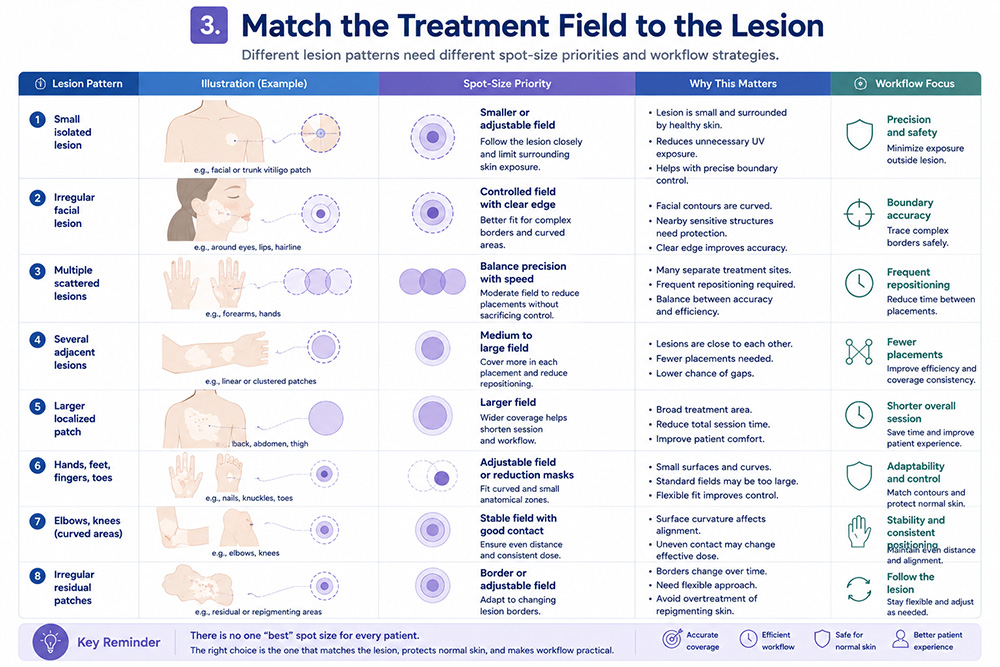
Matching Lesion Pattern to Treatment Workflow
The table below is not a treatment prescription. It is a practical framework for equipment evaluation.
| Lesion pattern | Spot-size priority | Main workflow concern |
|---|---|---|
| Small isolated lesion | Smaller or adjustable field | Limit unnecessary exposure outside the lesion |
| Narrow facial lesion | Controlled field with clear edge | Boundary accuracy and shielding |
| Multiple scattered lesions | Balance precision with fast repositioning | Number of treatment sites |
| Several adjacent lesions | Medium or larger field may help | Reduce repeated placements |
| Larger localized patch | Wider coverage may improve efficiency | Session duration and overlap control |
| Hands and feet | Flexible field or reduction masks | Curved surfaces and small anatomical zones |
| Elbows and knees | Stable treatment-head positioning | Angle and movement |
| Irregular residual patches | Adjustable masks or smaller field | Match changing lesion borders |
| Busy clinic workflow | Coverage plus documentation efficiency | Throughput without losing control |
The key word is balance.
Too small a field may increase treatment complexity.
Too large a field may reduce boundary control.
The ideal field is the one that covers the intended lesion accurately without making the session unnecessarily difficult.
What Patients Should Understand About Spot Size
Patients may see “large treatment area” or “precision spot” in product descriptions and assume one is automatically superior.
A more useful interpretation is:
A small spot may be useful when:
the lesion is small
the border is narrow
surrounding skin should be avoided
the body area is difficult to access
A larger spot may be useful when:
the lesion is broader
several lesions are close together
many small placements would otherwise be needed
shorter session workflow is important
However, spot size does not determine whether treatment will work.
Clinical response also depends on:
diagnosis
disease stability
anatomical location
treatment frequency
dose progression
adherence
skin response
combination therapy
individual biology
A larger spot does not guarantee faster repigmentation.
A smaller spot does not guarantee a better response.
Spot size mainly changes how the treatment is delivered.
What Clinics Should Ask Before Comparing 308nm Devices
A useful equipment comparison should begin with the clinic’s patients.
1. What lesion sizes are treated most often?
If most patients have small isolated lesions, an adjustable or smaller field may be valuable.
If larger localized patches are common, wider coverage may improve workflow.
2. Are lesions usually isolated, adjacent, or scattered?
Adjacent lesions may be covered efficiently with a larger field.
Scattered lesions still require separate positioning regardless of maximum spot size.
3. Is the treatment field fixed or adjustable?
Clinics should ask whether the device offers:
multiple apertures
reduction tips
treatment masks
adjustable spot size
interchangeable templates
shielding accessories
4. Is the field edge clearly defined?
A clear treatment boundary can help reduce accidental exposure outside the intended area.
5. How easily can the applicator be repositioned?
Handpiece weight, balance, cable movement, articulation, and treatment-head visibility affect repeated placements.
6. How is overlap controlled?
Ask whether the manufacturer provides guidance, templates, treatment maps, or other support for larger lesions.
7. Can treatment records identify lesion location?
For patients with multiple lesions, documentation may be as important as treatment speed.
8. Is the device practical for difficult anatomical areas?
A large spot may be impressive on paper but awkward on fingers, toes, ears, or facial contours.
9. What irradiance and dose-control modes are available?
Spot size should be evaluated together with output stability, dose mode, time mode, and MED workflow where applicable.
10. Does the system match the clinic’s patient volume?
A busy clinic needs efficient positioning, treatment delivery, cleaning, and record keeping—not only a large treatment window.
What Distributors Should Explain to Buyers
Distributors often lead with simple claims:
larger spot
faster treatment
high power
precise targeting
short treatment time
These claims may be partly true, but they are incomplete.
A more credible conversation begins with the customer’s workflow.
Ask:
What types of lesions do you treat most often?
Are lesions usually small, large, scattered, or adjacent?
Which body areas are most common?
How many patients are treated each day?
Does the clinic need adjustable masks?
Is treatment documentation important?
Does the clinic prioritize compact design or maximum coverage?
Will one operator treat many lesions in a single session?
A distributor should avoid claiming:
the largest spot is always best
a small spot is always more precise
larger coverage guarantees better results
spot size alone determines treatment time
all 308nm devices with similar treatment areas perform the same
The stronger message is:
Spot size should be matched to lesion pattern, anatomical location, dose workflow, and clinic volume.
That explanation is more useful than simply repeating the number of square centimetres.
How Spot Size Fits into 308nm Laser and LED Workflows
Both excimer laser systems and 308nm LED phototherapy devices can be used for targeted treatment, but their treatment fields, delivery systems, and operating logic may differ.
Some laser systems offer:
smaller adjustable spots
aiming beams
interchangeable templates
flexible apertures
Some 308nm LED systems offer:
broader fixed treatment areas
long-life light sources
compact clinical formats
dose and time modes
The practical comparison should not become:
laser equals precision, LED equals coverage
That is too simplistic.
Actual devices vary.
Some lasers offer larger treatment fields. Some LED systems use reduction masks. Some fixed-field devices may be highly practical for medium-sized lesions, while some adjustable laser systems may fit narrow borders well.
Technology matters.
But lesion-to-field matching still matters within each technology category.
What Spot Size Cannot Tell You About Clinical Response
Spot size can shape the workflow.
It cannot predict the patient’s outcome by itself.
Clinical response to 308nm treatment may vary according to:
body site
disease duration
lesion stability
hair-follicle density
acral involvement
treatment frequency
total number of sessions
dose tolerance
topical combination therapy
patient adherence
Facial and neck vitiligo often responds differently from acral lesions on the fingers and toes.
A device specification cannot remove those biological differences.
This is important for both patients and distributors.
The spot size should be presented as an operational feature—not as a guarantee of repigmentation or plaque clearance.
Conclusion: The Best Spot Size Is the One That Fits the Lesion
A smaller treatment spot may improve control around a small or irregular lesion.
A larger spot may reduce repositioning and make broader localized treatment more efficient.
Neither is universally better.
The right spot size depends on:
lesion size
lesion shape
lesion number
anatomical location
normal-skin protection
treatment-head stability
dose workflow
clinic volume
The most useful way to think about spot size is not: How large is the treatment window?
It is: How well does this treatment field match the lesions we actually need to treat?
In targeted phototherapy, precision does not simply mean using the smallest possible spot.
Precision means covering the intended lesion accurately, consistently, and without making the treatment unnecessarily difficult.
FAQ
What is spot size in 308nm phototherapy?
Spot size is the area of skin exposed during one placement of the treatment head. It may be fixed, adjustable, or modified using masks, apertures, or reduction tips.
Is a smaller spot always more precise?
No. A smaller spot may help follow narrow lesion boundaries, but treatment accuracy also depends on positioning, field visibility, operator technique, shielding, and overlap control.
Does a larger spot make treatment faster?
It can reduce the number of placements for larger or adjacent lesions. However, total session time also depends on dose, irradiance, lesion number, repositioning, patient positioning, and documentation.
Does spot size affect the UV dose?
Spot size describes the treatment area. Dose describes the energy delivered per unit area. A larger spot does not automatically mean a higher dose.
Why are overlap and gaps important?
When several placements are needed, overlapping areas may receive repeated exposure, while gaps may receive insufficient coverage. A consistent treatment sequence helps improve uniformity.
Is a large treatment area better for vitiligo?
It may be useful for larger localized or adjacent patches. Small, narrow, facial, or irregular lesions may benefit from a smaller or adjustable field.
Can the same spot size be used on every body area?
Not always. Flat areas, curved joints, fingers, toes, scalp margins, and facial lesions may require different positioning or apertures.
Does spot size determine treatment results?
No. Clinical response also depends on disease type, body site, lesion stability, dose, treatment frequency, adherence, and individual patient factors.
What should clinics check besides spot size?
Clinics should also evaluate irradiance, dose control, treatment-head handling, field-edge definition, masks, shielding, MED functions, treatment records, and service support.
What should distributors avoid claiming?
Distributors should not claim that the largest spot is always faster, that the smallest spot is always more precise, or that spot size alone determines clinical outcomes.
References
[1] Schatloff DH, et al. The Role of Excimer Light in Dermatology: A Review. 2024.
[2] DermNet New Zealand. Targeted Phototherapy.
[3] DermNet New Zealand. Excimer 308-nm Light Treatment.
[4] Yu Y, et al. A Prospective Randomized Half-Body Study Comparing 308nm LED Light and 308nm Excimer Laser for Vitiligo. 2023.
[5] Passeron T, et al. Use of the 308-nm Excimer Laser for Psoriasis and Vitiligo. 2006.
[6] Shi Q, et al. Comparison of the 308-nm Excimer Laser with the 308-nm Excimer Lamp in the Treatment of Vitiligo. Photodermatology, Photoimmunology & Photomedicine. 2013.
[7] Sun Y, et al. Treatment of Vitiligo with the 308-nm Excimer Laser: A Systematic Review. 2015.
[8] Majid I, Imran S. Efficacy of Targeted Narrowband UVB Therapy in Vitiligo. 2014.
[9] Feldman SR, et al. Efficacy of the 308-nm Excimer Laser for Treatment of Psoriasis: Results of a Multicenter Study. Journal of the American Academy of Dermatology. 2002.
[10] Mehraban S, Feily A. 308nm Excimer Laser in Dermatology. Journal of Lasers in Medical Sciences. 2014.