308nm Excimer Laser vs 308nm LED Phototherapy: How Clinics Should Choose Targeted Vitiligo Treatment Devices
2026-05-20 17:29
308nm Excimer Laser vs 308nm LED Phototherapy: How Clinics Should Choose Targeted Vitiligo Treatment Devices
Targeted phototherapy has become an important option in dermatology, especially when clinics need to treat localized vitiligo or other limited-area skin conditions without exposing the entire body to ultraviolet light. Among targeted devices, 308nm systems are often discussed because excimer light at 308nm is a subtype of narrowband UVB and can deliver focused treatment to affected areas.
For clinics and distributors, however, '308nm' alone is not enough to make a good equipment decision. A 308nm excimer laser system and a 308nm LED phototherapy device may both support targeted treatment workflows, but they are not the same in technology, positioning, operation, cost logic, or service model. The practical question is not which one sounds more advanced. The better question is which one fits the clinic’s patients, treatment workflow, budget, and long-term service strategy.
Why This Comparison Matters in Targeted Vitiligo Treatment
Vitiligo treatment often requires patience, repeated sessions, and realistic expectations. Lesion location, disease stability, treatment history, skin type, treatment adherence, and combination therapy can all influence outcomes. Targeted phototherapy is useful because it can focus energy on localized lesions, which may be especially relevant when full-body NB-UVB treatment is not necessary.
That does not mean every targeted device should be evaluated the same way. A hospital dermatology department, a specialized vitiligo clinic, a smaller outpatient skin clinic, and a distributor serving portable phototherapy markets may all need different equipment. The device format matters because it affects treatment precision, staff training, room setup, patient scheduling, maintenance, and how the service is positioned.
This is why comparing 308nm excimer laser and 308nm LED phototherapy is useful. It helps clinics avoid buying a device only because it carries the “308nm” label, and it helps distributors explain products according to real use cases instead of repeating generic claims.
What 308nm Excimer Laser and 308nm LED Phototherapy Have in Common
Both 308nm excimer laser and 308nm LED phototherapy belong to the broader category of targeted phototherapy. They are designed to treat specific areas rather than irradiating the whole body. This makes them relevant for localized vitiligo lesions, selected psoriasis plaques, and other limited skin areas where a targeted approach may be preferred.
Both also require structured use. Targeted phototherapy is not simply a matter of shining light on the skin. Clinics still need patient evaluation, dose planning, skin response monitoring, treatment intervals, and follow-up. The 2022 British Association of Dermatologists and British Photodermatology Group guidelines for narrowband UVB phototherapy emphasize the importance of protocols, dose logic, eye protection, monitoring, and safe operation in clinical phototherapy practice.
The shared value is clear: both device types can support focused treatment workflows. The difference lies in how they deliver the energy and how they fit into clinical and commercial use.
Where 308nm Excimer and 308nm LED Phototherapy Differ
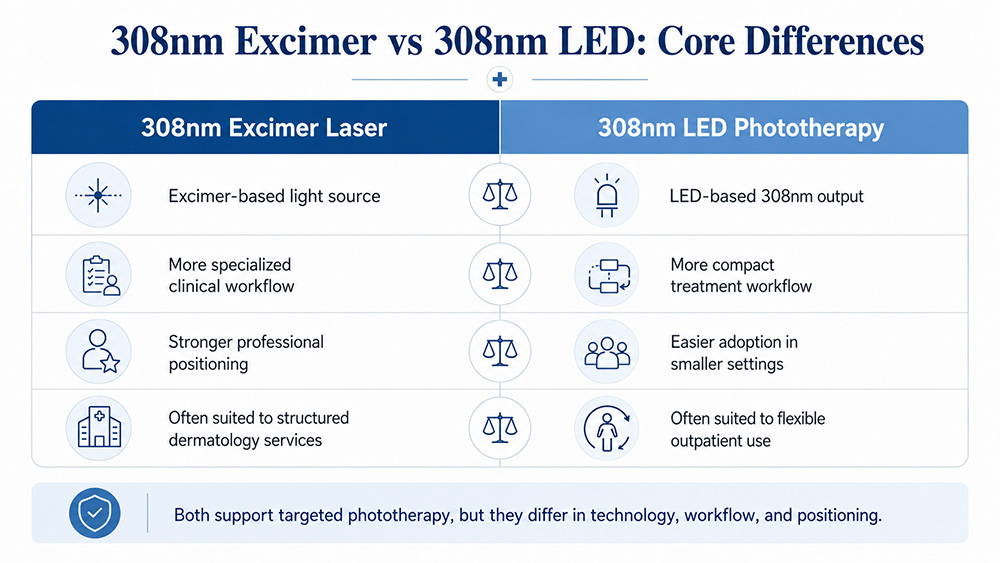
The first difference is the light source. A 308nm excimer laser system is commonly associated with xenon chloride excimer technology and targeted delivery of 308nm light. Excimer light has been discussed in dermatology as a focused form of NB-UVB, especially for conditions such as vitiligo and psoriasis.
A 308nm LED phototherapy device uses LED-based emission at or around the 308nm wavelength. The clinical and commercial logic is often different: LED-based devices may be positioned around easier adoption, lower operating complexity, compact structure, and more flexible clinic use. This does not automatically make them clinically equivalent to excimer systems in every case, but it does make them relevant for clinics looking for targeted phototherapy with a different device format.
The second difference is workflow. An excimer laser system is often positioned as a higher-spec professional device for structured dermatology departments or specialized vitiligo treatment services. LED-based targeted phototherapy may be easier to integrate into smaller outpatient settings, flexible treatment rooms, or distributor portfolios where portability and lower operating burden matter.
The third difference is commercial positioning. For a clinic, an excimer system may communicate a more specialized targeted phototherapy service. For a distributor, it may suit customers who are ready for a professional dermatology setup. LED-based 308nm phototherapy may suit customers who need simpler adoption, compact form factor, and easier entry into targeted phototherapy.
The point is not that one technology is always better. The point is that each technology fits different service models.
When a 308nm Excimer Laser System May Be the Better Fit
A 308nm excimer laser system may be the better fit when the clinic wants a more specialized targeted phototherapy platform. This can include hospital dermatology departments, dedicated vitiligo clinics, higher-volume outpatient skin centers, or practices that want to present targeted phototherapy as a professional service line.
This type of system may also be easier to justify when the clinic has enough patient volume and staff capability to support structured treatment protocols. If a clinic already manages many vitiligo or localized psoriasis patients, a professional excimer system can become part of a planned dermatology workflow rather than a rarely used device.
The clinical literature supports the role of 308nm excimer-based targeted phototherapy in vitiligo, although results can vary by lesion location and patient factors. Reviews note that excimer laser can be helpful in localized vitiligo, while also pointing out that response may be better in ultraviolet-sensitive areas and weaker in areas such as acral or joint lesions.
For distributors, this matters because the sales message should not be “laser is always better.” A stronger message is: excimer laser systems are better suited to customers who need a more specialized, professional, and protocol-driven targeted phototherapy service.
When 308nm LED Phototherapy May Be the Better Fit
A 308nm LED phototherapy device may be the better fit when a clinic needs targeted phototherapy in a more compact or flexible format. This can include outpatient dermatology clinics, smaller skin treatment centers, or buyers who want to add a 308nm service without immediately building a larger treatment room around a more complex system.
LED-based devices may also be easier for distributors to position in markets where customers are cautious about budget, space, operation, or service volume. If a clinic is just beginning to build a targeted phototherapy service, a 308nm LED device may offer a lower-footprint entry point.
That said, LED-based phototherapy should not be marketed carelessly. It should not be described as a universal substitute for every excimer laser use case unless supported by the device’s actual performance and clinical context. The responsible position is more precise: 308nm LED phototherapy may be a practical targeted option for selected clinics that value flexibility, compact design, and easier adoption.
What Clinics Should Evaluate Before Choosing Either Device
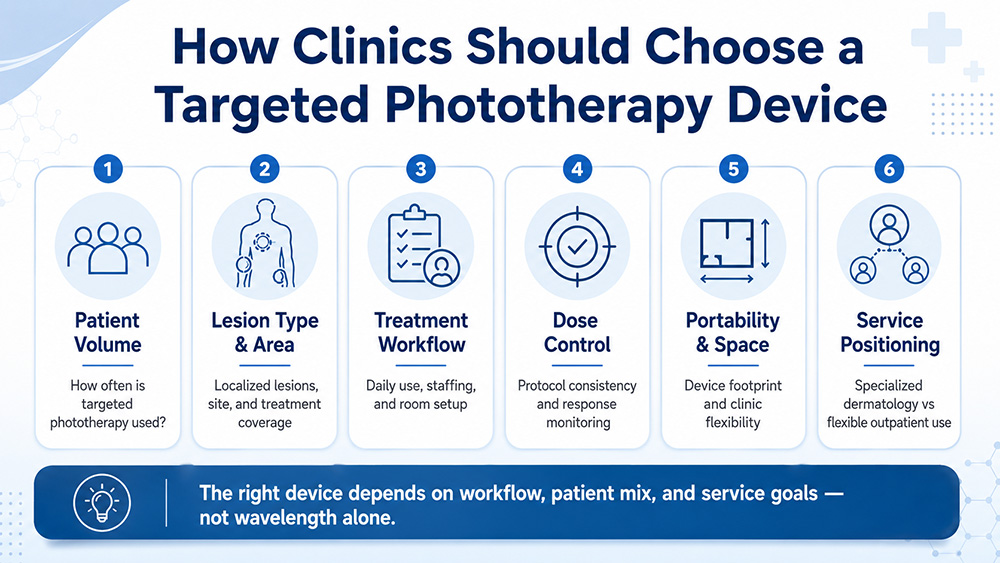
The first factor is patient volume. A clinic that regularly treats localized vitiligo and psoriasis patients may be able to justify a higher-spec excimer system. A clinic with lower case volume or a developing phototherapy program may prefer a more flexible LED-based setup.
The second factor is lesion type and treatment area. Localized facial or trunk lesions, acral lesions, joint areas, and larger scattered lesions may not respond or behave the same way. Clinics should evaluate what kinds of patients they actually see before choosing a device.
The third factor is workflow. A professional excimer system may require a more structured room, trained operators, and a planned treatment schedule. A compact LED device may be easier to move, easier to place, and easier to fit into a smaller clinic workflow.
The fourth factor is dose control and treatment consistency. Both device types need clear protocols, patient protection, and careful response monitoring. The British NB-UVB guideline materials reinforce that clinical phototherapy should be administered with attention to dosing, monitoring, safety, and appropriate procedures.
The fifth factor is positioning. Clinics should decide whether they want to build a specialized targeted phototherapy service, offer a flexible outpatient option, or create a product mix that includes both professional and portable systems.
The sixth factor is distributor support. For distributors, training, product explanation, service support, and customer segmentation may matter as much as the device itself. A technically strong device can still fail commercially if the distributor cannot explain who it is for.
What This Means for Distributors
Distributors should avoid presenting this comparison as a simple hierarchy. Saying “excimer is professional, LED is basic” is too shallow. Saying “LED is cheaper and easier” is also too weak. Buyers need a more useful explanation.
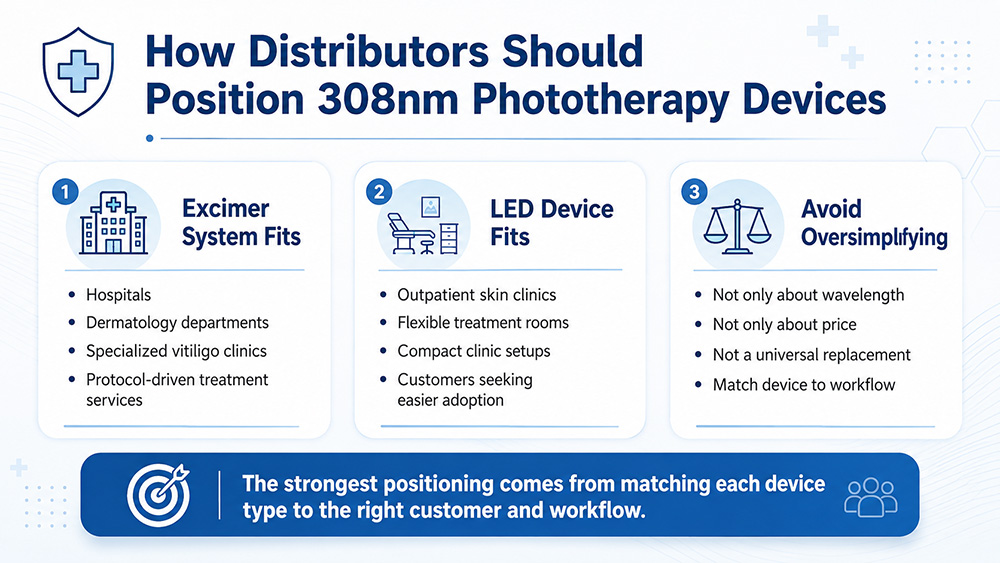
For hospitals and specialized dermatology centers, a 308nm excimer laser system may be easier to position as part of a professional targeted phototherapy service. The value message can focus on structured clinical use, targeted treatment, and professional dermatology workflow.
For smaller outpatient clinics, flexible skin treatment centers, and buyers building a new phototherapy service, a 308nm LED phototherapy device may be easier to position around compact setup, lower adoption burden, and practical daily use.
For distributors with a wider customer base, the best strategy may not be choosing only one category. It may be building a product portfolio that includes both excimer and LED-based 308nm options. That allows the distributor to match device type to customer type instead of forcing every customer into the same model.
Choosing Based on Workflow, Not Technology Names Alone
A common mistake in medical device buying is to compare names instead of workflows. “Excimer laser” and “308nm LED” sound like technology categories, but clinics do not operate technology names. They operate treatment rooms, patient schedules, staff workflows, and service models.
The better decision starts with practical questions:
How many targeted phototherapy patients does the clinic see?
Are the lesions mostly localized, scattered, stable, or difficult to treat?
Does the clinic need a professional treatment room or a flexible outpatient device?
Who will operate the device?
How will dosing and response be monitored?
What level of service positioning does the clinic want?
What kind of customer does the distributor actually serve?
These questions are more useful than asking only which technology sounds more advanced.
Conclusion
308nm excimer laser and 308nm LED phototherapy both belong in the targeted phototherapy conversation, but they should not be treated as identical. Excimer systems may be better aligned with specialized dermatology clinics, higher-spec targeted treatment workflows, and customers who need a professional service platform. LED-based 308nm phototherapy may be better aligned with flexible outpatient use, compact setup, and markets where easier adoption matters.
The right choice depends on patient type, clinic workflow, treatment goals, device operation, budget logic, and distributor positioning. For clinics and distributors, the strongest approach is not to ask which device is universally better. It is to ask which device fits the real targeted phototherapy workflow.
What is the main difference between 308nm excimer laser and 308nm LED phototherapy? The main difference is the light source and device workflow. A 308nm excimer laser system is generally positioned as a professional targeted phototherapy platform, while a 308nm LED phototherapy device may be more compact and flexible for selected outpatient workflows.
Are both used for vitiligo treatment? Both can be positioned within targeted phototherapy for localized vitiligo, depending on the device, patient selection, treatment protocol, and clinical judgment. Excimer-based 308nm treatment has stronger historical clinical literature in vitiligo, while LED-based systems may offer practical device-format advantages.
Is 308nm excimer laser always better than 308nm LED phototherapy? No. The better choice depends on clinic workflow, patient volume, treatment goals, budget, and service positioning. A professional excimer system may fit specialized dermatology settings better, while an LED-based device may fit clinics needing compact and flexible targeted treatment.
When should a clinic choose a 308nm excimer laser system? A clinic may consider an excimer system when it has a structured vitiligo or localized psoriasis workflow, sufficient patient volume, trained staff, and a need for professional targeted phototherapy positioning.
When may a 308nm LED phototherapy device be more suitable? A 308nm LED device may be more suitable when a clinic needs a compact, flexible, easier-to-adopt targeted phototherapy option, especially in smaller outpatient settings or early-stage service development.
What should distributors focus on when positioning these devices? Distributors should focus on customer type and workflow fit. Excimer systems may suit specialized dermatology customers, while LED-based 308nm devices may suit clinics looking for flexibility, compact setup, and easier adoption.