



Actinic Keratosis Field Treatment: Where Does Photodynamic Therapy Fit?
2026-09-09 15:10When Actinic Keratosis Becomes a Field Problem
When Actinic Keratosis Becomes a Field Problem
A patient may have three obvious actinic keratoses on the scalp.
Those lesions are easy to identify. The surrounding skin is more difficult to judge at a glance.
Years of ultraviolet exposure can leave a broader area of photodamage in which additional AKs may develop over time. In clinical practice, this wider pattern is often described as field cancerization.
For a single, well-defined lesion, individual treatment may be enough. Once multiple AKs are scattered across the same sun-damaged area, treating them one by one may no longer match the clinical problem.
This is the setting in which actinic keratosis field treatment becomes relevant.
European consensus guidance distinguishes between lesion-directed approaches for selected individual lesions and field-directed treatment for multiple AKs or field cancerization. Photodynamic therapy is one of the established options within that field-directed group.
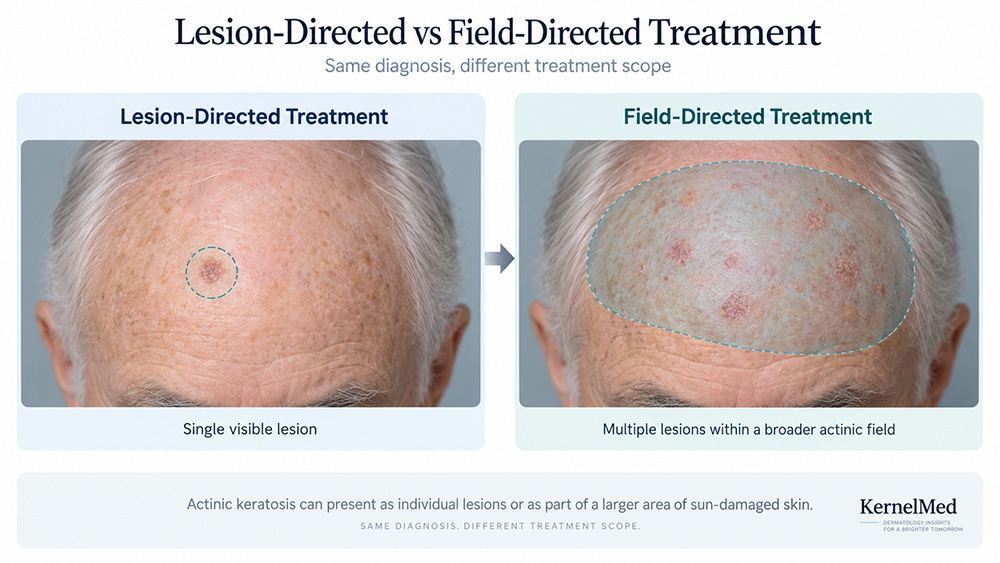
Lesion-Directed and Field-Directed Treatment
A single AK can often be managed individually, for example with cryotherapy.
A larger actinic field is different. Treatment may need to cover a broader area containing multiple visible lesions and clinically unapparent UV-related change.
The choice depends on lesion number, thickness, anatomical site, previous treatment, tolerability, adherence and patient preference.
The same diagnosis can therefore lead to very different treatment plans depending on how widely the disease is distributed.
What Field Cancerization Means
In clinical use, field cancerization refers to chronically UV-damaged skin in which multiple AKs may develop across the same anatomical area.
Common sites include the scalp, face, dorsal hands and forearms.
The term should not be interpreted to mean that all surrounding skin is malignant. Its value is practical: it helps clinicians recognize that several AKs may be part of a broader pattern of actinic damage rather than completely independent lesions.
That changes the question from:
Which visible lesion should be treated?
to:
Should this area be managed as a field?
Where PDT Fits
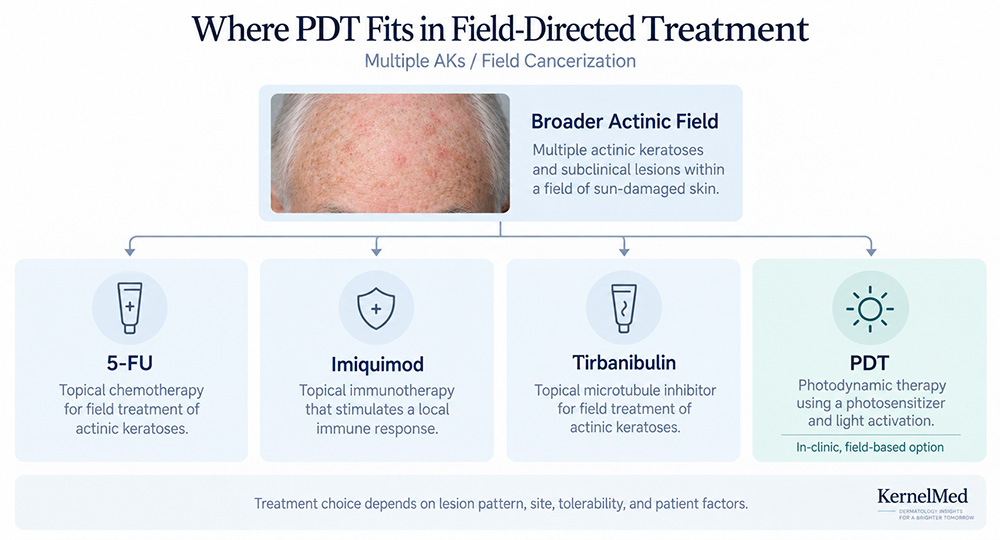
Photodynamic therapy is an established field-directed treatment for actinic keratosis.
It becomes most relevant after the clinician has already decided that the problem is a field rather than an isolated lesion. PDT can then be used to treat a defined area containing multiple AKs, provided the lesion characteristics, treatment site, photosensitizer, patient tolerance and local protocol are appropriate.
European guidance includes PDT among field-directed options for multiple lesions and field cancerization.
It is still one option among several.
Other field therapies include 5-fluorouracil, imiquimod, tirbanibulin and, in selected settings, diclofenac.
There is no single best field treatment for every patient. Some therapies require prolonged home application, some produce visible inflammatory reactions, and others require an in-clinic procedure. The practical choice depends on the field, the patient and the treatment setting.
When Thicker AKs Make PDT More Difficult
PDT may be more challenging in thicker or hyperkeratotic AKs because lesion surface characteristics can limit photosensitizer penetration.
A 2026 scoping review of 14 human studies examined laser pretreatment before PDT for AKs and field cancerization. Several studies reported better clearance or lesion reduction after pretreatment, with the clearest benefit seen in thicker lesions and treatment-resistant fields.
The evidence is promising, but it is not a reason to make laser-assisted PDT routine for every patient. The included studies used different lasers and PDT protocols, and long-term comparative data remain limited.
For selected difficult fields, pretreatment may help address a barrier that standard PDT does not fully overcome.
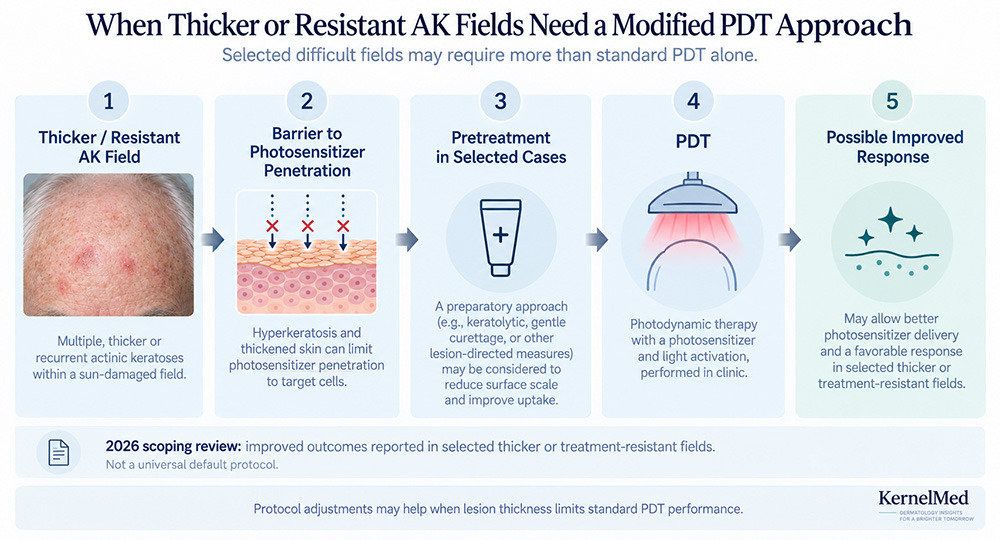
2026 scoping review: improved outcomes reported in selected thicker or treatment-resistant fields
PDT Field Treatment Requires a Workflow
Once PDT is selected, the treatment is more than illumination.
A typical clinical workflow may include:
defining the treatment field;
preparing lesions where appropriate;
applying the photosensitizer;
allowing the required incubation period;
positioning the light source;
delivering illumination according to protocol;
managing discomfort;
documenting the treated area;
follow-up.
The exact protocol varies with the photosensitizer, indication, device and local clinical practice.For a closer look at how photosensitizer choice, wavelength, irradiance, fluence and treatment-field geometry work together, see our guide to [PDT treatment parameters in dermatology]
For clinics, equipment should therefore be assessed in the context of the treatment workflow it needs to support.
Where the KernelMed KN-7000L Fits
For clinics using light-source-based PDT, equipment needs to fit the treatment field and protocol rather than simply offer a long specification list.
KernelMed's KN-7000L is designed around this type of clinical workflow, with adjustable treatment-head positioning, real-time intensity monitoring, thermal management, and continuous or pulsed irradiation modes.
These features relate to light delivery and workflow. Whether PDT is appropriate for a particular AK field remains a clinical decision.
For clinics and distributors comparing professional LED light therapy systems, the more useful question is whether the equipment can support the treatment field and protocol the clinic intends to use.
Practical Takeaway
Actinic keratosis is not always an isolated-lesion problem.
When multiple AKs develop within chronically sun-damaged skin, treatment planning may shift toward the field as a whole.
PDT has an established place in that strategy, alongside topical field therapies and other approaches. Its role depends on appropriate lesion selection, the treatment site, patient tolerance and a protocol suited to the field being treated.
For thicker or resistant AKs, newer evidence suggests that pretreatment may improve PDT response in selected cases, although it is not yet a universal standard.
The clinical sequence is straightforward:
assess the field → choose the treatment strategy → select the protocol → then choose the equipment that supports it
FAQ
Is PDT a field-directed treatment for actinic keratosis?
Yes. PDT is an established field-directed option for multiple AKs and field cancerization when used under an appropriate clinical protocol.
Is PDT the best treatment for multiple actinic keratoses?
There is no single best option for every patient. PDT, 5-FU, imiquimod and tirbanibulin have different advantages and treatment burdens, so lesion pattern, site, tolerability and patient preference all matter.
Why are thick or hyperkeratotic AKs harder to treat with PDT?
Thicker lesions may limit photosensitizer penetration. A 2026 scoping review suggests that laser pretreatment may improve outcomes in selected thicker or treatment-resistant fields, but long-term comparative evidence remains limited.
Does field treatment prevent squamous cell carcinoma?
Field treatment is used to manage AKs and actinic field damage. It should not be presented as guaranteeing prevention of cutaneous squamous cell carcinoma.
References
European consensus-based interdisciplinary guideline for diagnosis, treatment and prevention of actinic keratoses, epithelial UV-induced dysplasia and field cancerization
https://pubmed.ncbi.nlm.nih.gov/38451047/Boostani M, et al. Advances in enhancing photodynamic therapy for actinic keratoses and field-damage with laser pretreatments: A scoping review. 2026.
https://pubmed.ncbi.nlm.nih.gov/42492748/American Academy of Dermatology — Actinic Keratosis Clinical Guideline
https://www.aad.org/member/clinical-quality/guidelines/actinic-keratosis