



Why One IOP Reading Is Not Enough: Portable Rebound Tonometer for IOP Screening
2026-06-10 17:08Why One IOP Reading Is Not Always Enough: Rethinking Eye Pressure Screening with Rebound Tonometry
What if a patient’s highest eye pressure does not happen during the clinic visit?
That question is simple, but it changes how we think about intraocular pressure measurement. In many eye-care settings, IOP is treated as a single number. A patient sits down, the pressure is measured, and the result is recorded.
That number matters. But it is still only one moment.
Eye pressure can change across the day. It can also vary between visits, measurement conditions, patient cooperation, body position, and clinical context. For glaucoma screening, ocular hypertension follow-up, mobile eye care, and guided monitoring workflows, the practical question is not only:
“What is the pressure now?”
A better question is:
“Can IOP be measured reliably, repeatedly, and in the right setting?”
This is where rebound tonometry becomes more interesting than a simple product category. A portable rebound tonometer is not valuable only because it is small or handheld. Its stronger value is that it can make IOP screening easier to repeat, easier to document, and easier to integrate into real eye-care workflows.
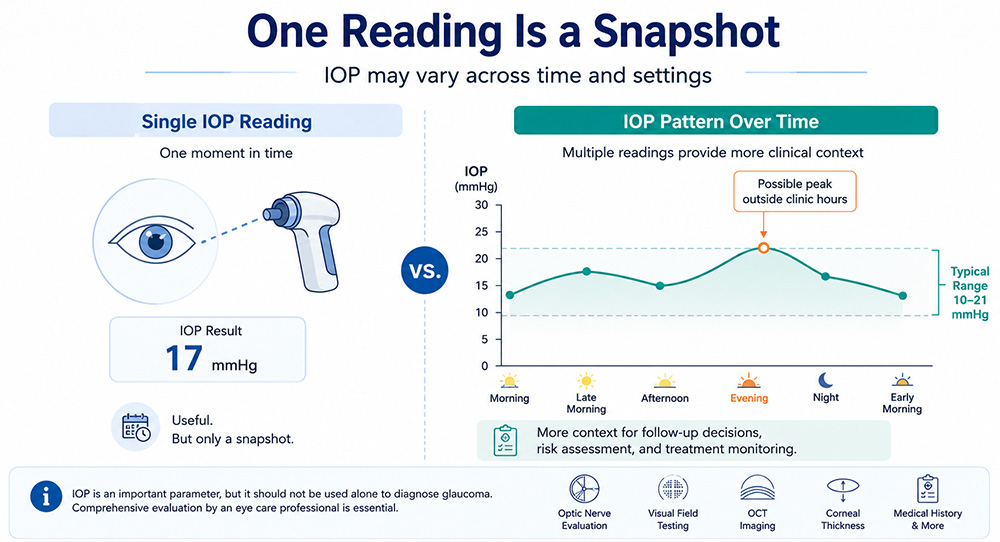
One IOP Reading Is a Snapshot, Not the Whole Story
Intraocular pressure, or IOP, is one of the most familiar numbers in eye care. It is closely related to glaucoma risk and ocular hypertension management. But IOP alone does not diagnose glaucoma.
A single reading may show that pressure is within a usual reference range. It may also show that pressure is higher than expected. Both results can be useful. But neither result should be interpreted without clinical context.
A normal IOP reading does not automatically rule out glaucoma. An elevated reading does not automatically confirm it. Eye-care professionals may still need to consider optic nerve appearance, visual field testing, OCT imaging, corneal thickness, patient history, medication use, and other findings.
This is why one IOP reading should be understood as a snapshot.
It tells you what the pressure was at one point in time, under one set of conditions. It does not always tell you whether the pressure rises at another time of day, whether the patient has meaningful fluctuation, or whether repeated measurements remain consistent.
For readers who want a broader introduction to the technology, our guide to rebound tonometers for IOP screening explains how the measurement method works and where it is commonly used.
For clinics and distributors, this distinction matters. A tonometer should not be evaluated only by how fast it produces a number. It should also be evaluated by whether it supports repeatable, practical, and responsible IOP screening.
Why IOP Can Vary Across Time and Settings
IOP is not a fixed number. It can vary during the day and from one visit to another. In glaucoma care, this matters because pressure peaks and fluctuations may not always be captured during a routine office-hour measurement.
This does not mean every patient needs all-day monitoring. It also does not mean repeated measurement automatically answers every clinical question. But it does explain why a single measurement should not be overinterpreted.
In real practice, IOP can be affected by several factors:
time of day
measurement position
patient cooperation
eyelid squeezing
corneal characteristics
measurement technique
medication timing
follow-up interval
whether the measurement is taken in clinic, screening, or home-guided contexts
For routine screening, a single reading may be enough to decide whether further attention is needed. For some patients, however, repeat measurement or follow-up may provide more useful context.
That is why the device workflow matters.
If a clinic wants to repeat IOP measurement, screen patients outside a standard examination room, or document results during mobile eye care, the tonometer must make that process realistic.
Why Repeatable IOP Screening Matters in Real Eye-Care Workflows
IOP screening is not only about detecting one high number. It is also about deciding what should happen next.
Should the patient be rechecked?
Should the result be documented for follow-up?
Should the patient be referred for a full glaucoma evaluation?
Should the clinic repeat the measurement under better conditions?
Should the screening team keep a record for later review?
These are workflow questions, not just measurement questions.
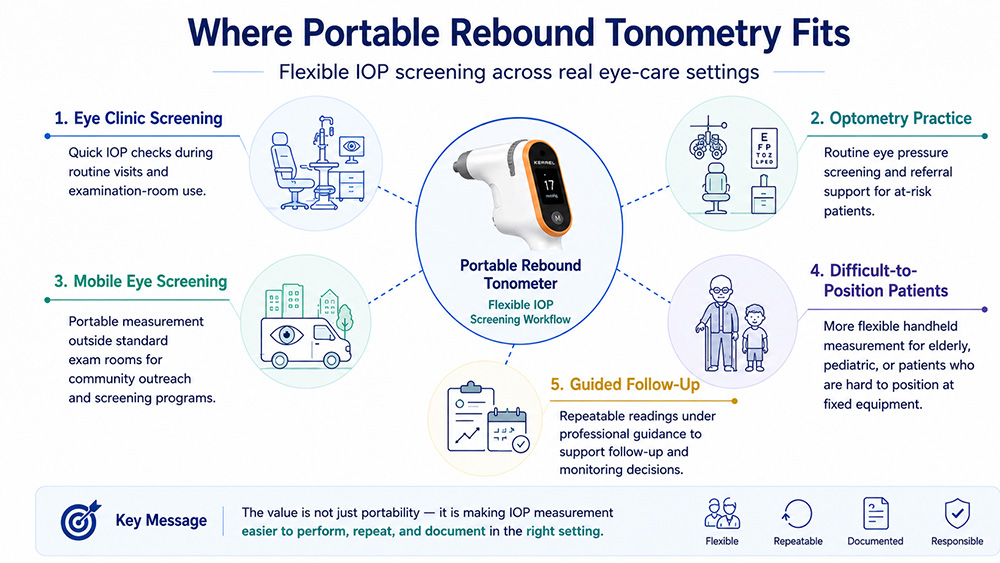
In an ophthalmology clinic, repeatable IOP measurement may help confirm whether a reading is consistent. In an optometry practice, it may support routine eye checks and referral decisions. In mobile screening, it may help staff collect basic pressure data in communities where access to eye care is limited. In elderly or pediatric patients, a handheld approach may reduce positioning difficulties compared with some fixed devices.
The point is not that more measurements are always better. The point is that when repeated measurement is clinically useful, the workflow should not make it difficult.
A practical IOP screening workflow should answer three basic needs:
Can the measurement be performed efficiently?
Can the result be recorded clearly?
Can abnormal or uncertain results be followed up responsibly?
A rebound tonometer can support this type of workflow when it is selected and used appropriately.
What a Portable Rebound Tonometer Changes
Rebound tonometers are often described with familiar phrases: portable, handheld, quick, easy to use, and usually not requiring topical anesthesia.
Those points are useful, but they are not enough.
The deeper value of a portable rebound tonometer is that it changes where and how IOP measurement can happen. Instead of requiring every patient to adapt to a fixed measurement position, a trained operator can bring handheld IOP measurement into more flexible settings.
This can be valuable in:
eye clinics with multiple examination rooms
optometry practices doing routine eye checks
mobile screening programs
community eye-care activities
nursing homes or elderly care settings
pediatric screening situations
patients who are difficult to position at fixed equipment
guided follow-up workflows where repeat measurement is needed
A portable rebound tonometer does not replace a complete eye examination. It also does not remove the need for professional interpretation. But it can make IOP screening more accessible in the settings where screening actually happens.
This is why clinics should think beyond device size. The best handheld tonometer is not simply the smallest one. It is the one that fits the intended screening workflow.Clinics still comparing measurement technologies can also review our guide to rebound tonometer vs air-puff tonometer workflows.
Choosing by Workflow, Not by Specs Alone
Many buyers compare tonometers by basic specifications: measurement range, probe type, display, size, battery, printing, or data transfer. These details matter, but they should be connected to the actual use case.
A clinic that mainly performs quick in-office screening may need a simple, stable handheld workflow. A mobile screening team may care more about portability, wireless printing, and result documentation. A guided follow-up program may care more about repeatability, positioning support, and user training.
In other words, the right question is not only:
“Which rebound tonometer has more features?”
The better question is:
“Which features make sense for the way this buyer will actually measure IOP?”
For example, in workflows where handheld positioning is difficult, a dual-support rebound tonometer may help make assisted or guided IOP measurement more stable. In mobile screening environments, features such as wireless printing and app-side data exchange can make IOP results easier to document and review.
This is the right way to introduce product differences: not as a model-by-model advertisement, but as workflow matching.
A portable rebound tonometer should be evaluated by how well it supports the intended environment, operator, patient group, and documentation needs.
What Clinics Should Evaluate Before Choosing a Rebound Tonometer
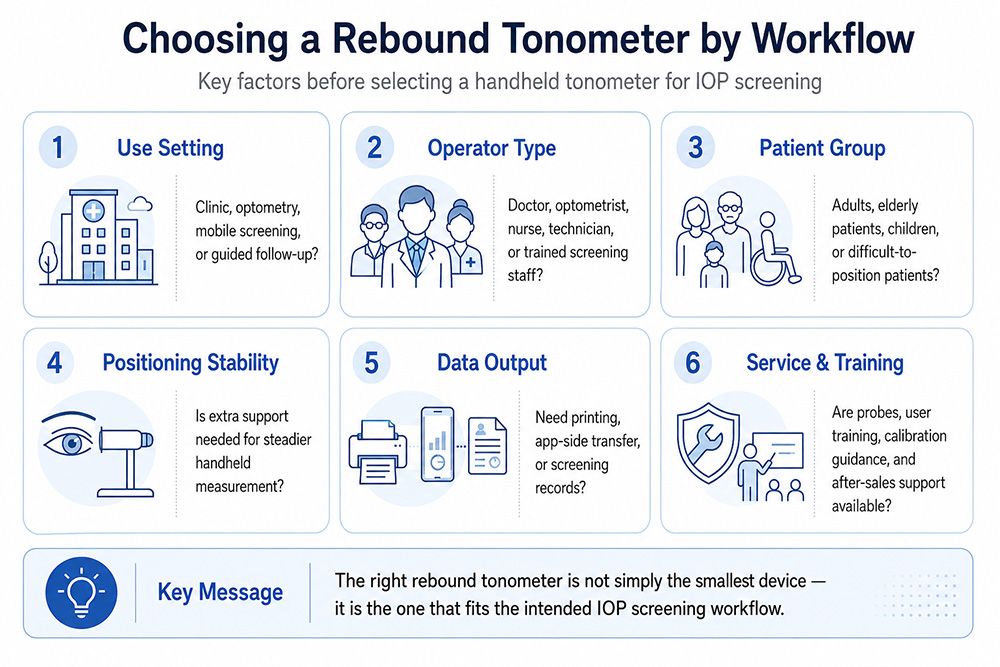
Before choosing a rebound tonometer, clinics should start with the workflow.
The first question is where the device will be used. A tonometer used inside an ophthalmology clinic may have different requirements from one used in community screening or optometry chains.
The second question is who will operate it. Will the user be an ophthalmologist, optometrist, nurse, technician, screening staff member, or selected patient under professional guidance? The operator affects training needs and usability expectations.
The third question is whether repeat measurement is part of the workflow. If the clinic only needs occasional spot checks, a simple workflow may be enough. If the clinic wants to support follow-up, screening records, or guided repeated measurement, documentation and positioning stability become more important.
The fourth question is the patient group. Pediatric patients, elderly patients, and patients with limited mobility may benefit from a more flexible handheld measurement workflow.
The fifth question is data handling. Does the clinic need printed results? Does it need app-side transfer? Does it need a simple screening record? Does the result need to be shared with another doctor, department, or follow-up team?
The sixth question is support. Training, calibration guidance, probes, warranty, service, and distributor support materials all affect long-term adoption.
A practical checklist should include:
intended use setting
operator type
target patient group
positioning stability
repeat measurement needs
data output and printing
mobile screening requirements
training requirements
maintenance and service support
distributor support materials
This is how clinics should evaluate rebound tonometry: not as a generic device category, but as a practical IOP screening workflow.
What Distributors Should Explain to Buyers
Many buyers search for a portable tonometer or handheld tonometer. But distributors should not stop the conversation at “portable” or “easy to use.”
Those words are common. They are not enough to build confidence.
A stronger distributor conversation starts with the buyer’s actual use scenario.
For ophthalmology clinics, the discussion may focus on quick screening, repeat measurement, and examination-room flexibility. For optometry centers, the focus may be routine eye checks and referral support. For mobile screening teams, portability, printing, and data transfer may be more important. For guided follow-up workflows, positioning support and user instruction may matter more.
Distributors should explain:
who the device is best suited for
where it can be used efficiently
how results are recorded
whether printing or data transfer is needed
whether the patient group requires special positioning support
what level of operator training is required
what should happen when readings are abnormal or inconsistent
This is more credible than simply saying “fast, portable, no anesthesia.”
The strongest message is workflow fit.
A rebound tonometer should be positioned as a tool that supports practical intraocular pressure measurement in the right setting — not as a device that replaces clinical judgment.
What Rebound Tonometry Should Not Be Oversold As
Credible medical device content needs clear boundaries.
A rebound tonometer measures IOP. It does not diagnose glaucoma by itself.
Glaucoma evaluation may involve optic nerve examination, visual field testing, OCT imaging, corneal thickness assessment, gonioscopy, medical history, and professional judgment. IOP is important, but it is only one part of the picture.
A rebound tonometer also does not eliminate IOP variability. It makes measurement more accessible and repeatable, but results still depend on correct technique, patient cooperation, device use, and clinical interpretation.
Home or self-measurement should also be described carefully. In selected cases, guided self-tonometry may help collect additional IOP information, but it should not be promoted as unsupervised self-diagnosis.
This type of careful positioning does not weaken the article. It makes the content more trustworthy.
Clinics and distributors need claims that can stand up in real conversations with doctors, buyers, and regulatory reviewers.
Conclusion: From One Reading to Practical IOP Screening
One IOP reading matters. But it may not always tell the whole story.
Eye pressure can vary across time and settings. Some patients may need repeat measurement, follow-up, or additional evaluation. For this reason, modern IOP screening should not be viewed only as getting one number. It should be viewed as a workflow: measuring, repeating when needed, documenting, reviewing, and interpreting results responsibly.
A portable rebound tonometer supports this shift by making intraocular pressure measurement more accessible in clinics, optometry practices, mobile eye-care programs, and guided follow-up settings.
For clinics, the better question is not simply:
“Can this tonometer measure eye pressure?”
The better question is:
“Can this tonometer support the way we actually screen, repeat, document, and follow up IOP readings?”
For distributors, the strongest message is not just portability. It is workflow fit.
Explore KernelMed rebound tonometer solutions for clinic screening, mobile eye care, wireless documentation, and guided IOP monitoring workflows.
FAQ
Is one IOP reading enough to evaluate eye pressure?
One IOP reading is useful, but it is only a measurement at one moment. IOP can vary across time and settings, so some patients may need repeat measurement or further eye-care evaluation.
Why can intraocular pressure change during the day?
IOP may vary due to daily rhythm, body position, medication timing, patient cooperation, measurement conditions, and individual eye characteristics. This is why repeated measurement can sometimes provide more useful context than one isolated reading.
What is a rebound tonometer?
A rebound tonometer is a device used for intraocular pressure measurement. It uses a small probe that briefly contacts the cornea and rebounds. Many rebound tonometers are handheld and are used in portable IOP screening workflows.
What is the value of a portable rebound tonometer?
Its value is not only portability. A portable rebound tonometer can make IOP screening easier to perform in clinics, optometry practices, mobile screening programs, and guided follow-up environments.
Does rebound tonometry require anesthesia?
Many rebound tonometers are designed for measurement without topical anesthesia, but users should always follow the device instructions and local clinical practice requirements.
Can patients measure IOP by themselves?
Selected guided self-measurement workflows may be possible with appropriate device design, training, and professional supervision. However, self-tonometry should not be treated as self-diagnosis.
Does a rebound tonometer diagnose glaucoma?
No. A rebound tonometer measures IOP. Glaucoma diagnosis requires broader clinical assessment, which may include optic nerve evaluation, visual field testing, OCT, corneal thickness measurement, and professional judgment.
What should clinics consider before choosing a handheld tonometer?
Clinics should evaluate the intended setting, operator type, patient group, positioning stability, repeat measurement needs, data output, training requirements, and service support.
References
[1] American Academy of Ophthalmology. Eye Pressure Testing.
[2] American Academy of Ophthalmology. Eye Pressure.
[3] Konstas AG et al. Diurnal and 24-h Intraocular Pressures in Glaucoma.
[4] Ho CH et al. Role of 24-Hour Intraocular Pressure Monitoring in Glaucoma Management.
[5] Cvenkel B et al. Self-monitoring of intraocular pressure using iCare HOME tonometry in clinical practice.
[6] KernelMed CN-1612 and CN-1613 product information.