



Rebound Tonometer vs Air-Puff Tonometer: Which Fits Modern Eye Clinic Screening Workflows?
2026-04-08 17:37Rebound Tonometer vs Air-Puff Tonometer: Which Fits Modern Eye Clinic Screening Workflows?
Intraocular pressure measurement is a routine part of eye care, but the choice of tonometer is often discussed too simply. In practice, clinics are not only choosing a number on a screen. They are choosing how pressure is measured, how easily patients tolerate the test, how the device fits screening flow, and how practical it is in real outpatient settings. Tonometry is a standard method for measuring intraocular pressure, and commonly cited normal ranges are around 10 to 21 mmHg.[1]
That is why the comparison between rebound tonometry and air-puff tonometry is still useful. This is not just a comparison between contact and non-contact approaches. It is also a comparison between two screening workflows. One is often associated with handheld rebound tonometry and quick point-of-care use. The other is commonly associated with familiar non-contact screening in fixed clinic setups.[2][3]
Why This Comparison Matters
A good tonometer should fit the way a clinic actually works. In some settings, the priority is a quick non-contact test for high patient volume. In others, the priority is portability, flexibility, and easier use in community screening, bedside assessment, or pediatric settings. Those are not minor differences. They directly affect efficiency, patient cooperation, and whether the device is used consistently.
Published studies also show that rebound tonometry and non-contact air-puff tonometry should not be treated as perfectly interchangeable. A 2019 comparison study in healthy subjects found statistically significant differences between rebound tonometry, non-contact air-puff tonometry, and Goldmann applanation tonometry, even though the authors also reported strong correlations among methods.[2] That means clinics should not reduce the choice to marketing claims about convenience alone.
What Is the Difference Between a Rebound Tonometer and an Air-Puff Tonometer?
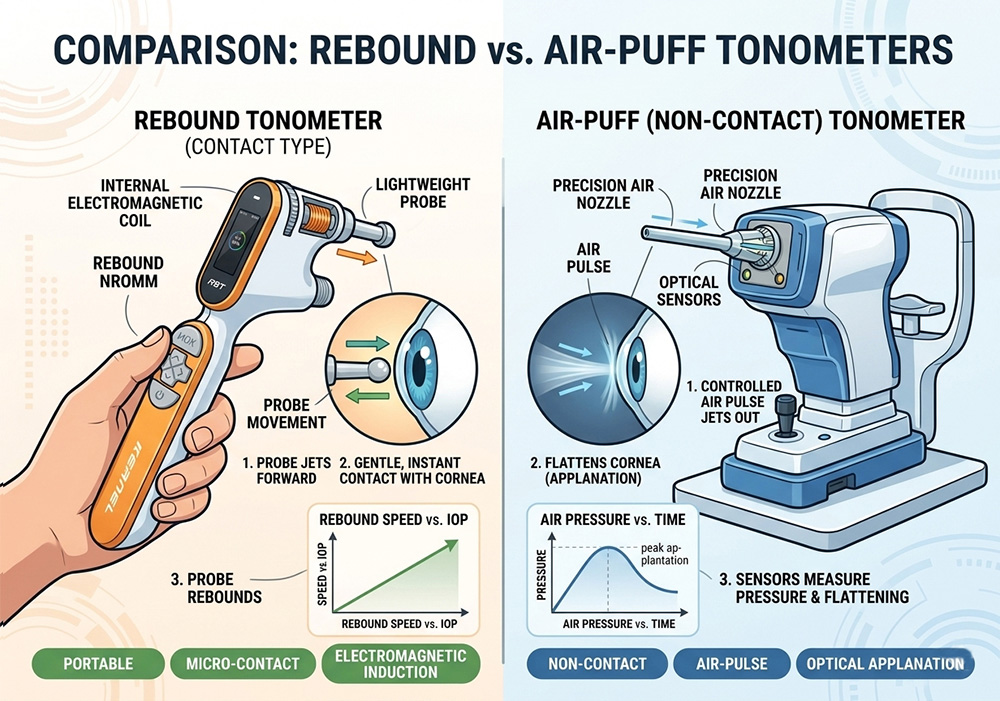
A rebound tonometer measures intraocular pressure using a small lightweight probe that makes brief contact with the cornea. One practical reason it has become popular is ease of use. Reviews describe rebound tonometry as widely adopted because of its simple operating principle and practical workflow.[3]
An air-puff tonometer, often referred to as a non-contact tonometer, uses a pulse of air rather than a probe touching the cornea. This makes it familiar in many screening environments because it avoids direct corneal contact and is often associated with quick front-desk or routine screening workflows.[2][4]
The difference sounds simple, but it affects more than patient experience. It changes device size, portability, maintenance logic, screening setup, and how easily the instrument can move beyond a fixed examination room.
When a Rebound Tonometer May Be the Better Fit
A rebound tonometer may be the better fit when portability and flexibility matter. This is especially relevant in clinics that run outreach programs, mobile screening, bedside assessment, or quick point-of-care pressure checks. A handheld device can reduce setup burden and fit more naturally into workflows that do not revolve around a fixed instrument station.
Rebound tonometry also has a meaningful place in pediatric use. The American Academy of Ophthalmology’s ophthalmic technology assessment concluded that rebound tonometry appears reasonably accurate in many children and allows IOP measurement without general anesthesia in many cases.[5] That does not mean it eliminates all measurement concerns, but it does show why rebound tonometry is often discussed as more feasible in child-friendly or lower-barrier workflows.
Another practical point is patient experience. A rebound device does not use an air blast, and that can make screening feel less disruptive for some patients. It also avoids the visual anticipation that sometimes makes air-puff testing uncomfortable or inconsistent in anxious patients. That kind of workflow detail is often more relevant in practice than broad claims about one technology being “better.”
This is also where portable rebound tonometer design becomes especially relevant in real screening workflows. Current rebound tonometer models increasingly emphasize handheld form factors, mobile screening suitability, wireless printing, and APP-side data exchange, which are all features tied to workflow rather than abstract specifications.[6][7]
When an Air-Puff Tonometer May Still Be the Better Fit
An air-puff tonometer may still be the better fit when clinics want a familiar non-contact screening process in a stable, fixed setting. For high-volume general screening environments, non-contact operation can be appealing because it fits a standardized workflow and avoids probe-based contact with the cornea.
This is also why air-puff tonometry remains common in many routine screening settings. It can be quick, recognizable to staff, and easy to position within established examination flow. A 2025 comparative evaluation described the air-puff tonometer as non-contact, easy to use, and quick in glaucoma screening contexts, even while comparing it against other methods.[4]
That said, “non-contact” should not automatically be interpreted as “best for every clinic.” Air-puff systems may suit fixed-room screening more naturally than mobile or flexible use. They also do not solve every measurement limitation, and published comparisons continue to show method-dependent differences.[2][4]
What Clinics Should Evaluate Before Choosing Either Workflow
The first question should be practical: where and how will the device be used? If the clinic needs a portable device for flexible IOP checks, rebound tonometry may make more sense. If the clinic prefers a fixed non-contact screening setup, air-puff tonometry may still be a better operational fit.
The second question is population. If children, anxious patients, or outreach settings are part of routine work, rebound tonometry deserves serious consideration because feasibility and cooperation may matter as much as raw throughput.[5]
The third question is data handling and workflow support. A device that works well in real clinics is not only one that measures IOP, but one that fits how results are recorded, transferred, printed, or reviewed. That is one reason some portable rebound tonometer systems are increasingly positioned around wireless printing, onboard data handling, and mobile screening use rather than around a generic feature list.[6][7]
The final point is interpretation. Clinics should not assume that different tonometry methods can always be substituted without context. Comparative studies show correlation, but also show differences in measured values between methods.[2][8] For that reason, the real question is not which device sounds more advanced. It is which device fits the clinic’s examination environment and follow-up logic.
Choosing Based on Workflow, Not Just Method
A common mistake is to compare tonometers only as technologies. In practice, the more useful comparison is workflow-based. A rebound tonometer may be the better choice when portability, lower setup burden, and patient cooperation are priorities. An air-puff tonometer may still be the better choice when the clinic wants familiar non-contact screening in a fixed station.
That is a more honest way to compare the two. It avoids empty claims and keeps the decision tied to actual clinical use. The better device is not the one with the strongest brochure language. It is the one that fits the screening model the clinic actually runs.
Conclusion
Rebound tonometers and air-puff tonometers support different screening styles. Rebound tonometry is often better aligned with portable, flexible, and lower-barrier workflows, especially where mobile screening or pediatric feasibility matters. Air-puff tonometry may still fit well in fixed non-contact screening environments. The choice should be based on clinic workflow, patient population, and practical use rather than broad assumptions about which method is newer or simpler.
Explore KernelMed's ophthalmic tonometer solutions for portable IOP screening and clinic-friendly workflow support.
FAQ
What is the main difference between a rebound tonometer and an air-puff tonometer?
A rebound tonometer uses a lightweight probe with brief corneal contact, while an air-puff tonometer measures IOP using a pulse of air in a non-contact workflow.[2][3]
Is rebound tonometry more suitable for portable screening?
Often yes. Rebound tonometers are commonly described as easy to use and well suited to portable or mobile screening scenarios, and your current product line is positioned that way as well.[3][6][7]
Is air-puff tonometry always better because it is non-contact?
No. Non-contact operation can fit some screening environments well, but method differences remain, and the best choice depends on workflow and population.[2][4]
Can rebound tonometry be useful in children?
Yes. The AAO technology assessment concluded that rebound tonometry seems reasonably accurate in many children and can often be used without general anesthesia.[5]
Should clinics treat rebound and air-puff measurements as fully interchangeable?
Not automatically. Studies show strong correlations but also significant differences between methods, so interpretation should take method context into account.[2][8]
References
[1] StatPearls. Tonometry.
[2] Demirci G, et al. Comparison of rebound tonometry and non-contact airpuff tonometry in healthy subjects. 2019.
[3] Nakakura S. Icare rebound tonometers: review of their characteristics and clinical applicability. 2018.
[4] Khalil KM, et al. Evaluation of the Accuracy of Air-puff Tonometer Compared to Other Tonometers. 2025.
[5] American Academy of Ophthalmology. Rebound Tonometry in Children OTA.
[6] KernelMed. Handheld Rebound Tonometer with Dual Support CN-1612.
[7] KernelMed. Portable Rebound Tonometer with Wireless Printing CN-1613.
[8] Kageyama M, et al. Comparison of ICare rebound tonometer with noncontact tonometer in healthy young subjects. 2011.