



Integrated Review of Landmark Dermatology Research: A Joint Analysis of JAAD, JAMA Dermatology, and JEADV (December 2025 Issue)
2026-01-14 17:38Overview of the Journals
Journal Information at a Glance
| Journal | Latest Issue | Core Focus | Key Topics |
|---|---|---|---|
| JAAD | December 2025 | Official journal of the American Academy of Dermatology | Clinically oriented, therapeutic innovation |
| JAMA Dermatology | December 2025 | Evidence-based dermatology | Randomized controlled trials, systematic reviews |
| JEADV | December 2025 | Official journal of the European Academy of Dermatology and Venereology | Translational research, clinical practice, AI applications |
Together, these three journals represent the highest level of dermatology scholarship across North America and Europe, offering complementary perspectives from foundational science to real-world clinical implementation.
Key Research Domains: Integrated Analysis
I. Advances in Atopic Dermatitis (AD) Management
1. Infection Risk and Long-Term Safety
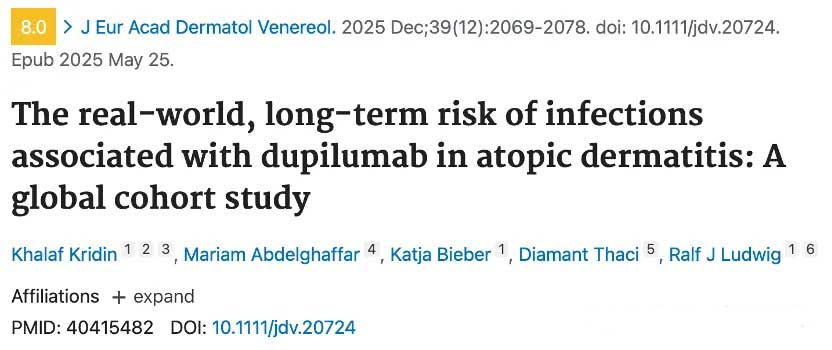
Source: JEADV – Global Cohort Study
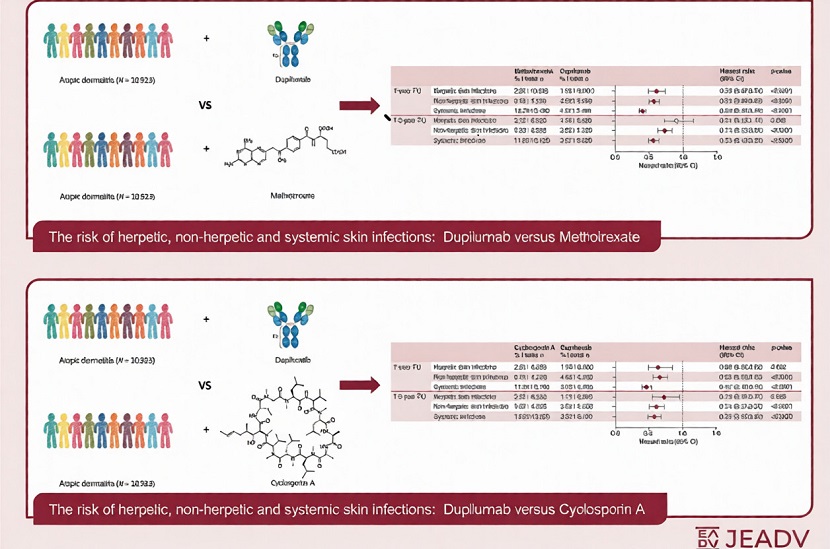
A large-scale analysis using the TriNetX global health database evaluated infection risk among patients receiving dupilumab.
Study population: 10,913 matched patient pairs
Follow-up duration: Up to 3 years
Key findings:
Significant reduction in 32 categories of infections
Hazard ratios ranged from 0.39 to 0.68
Clinical implication:
Both cutaneous and systemic infection risks were reduced, supporting dupilumab as a suitable option for patients with heightened susceptibility to infections.
2. Early Prediction and Preventive Strategies
Source: JEADV – Danish Birth Cohort
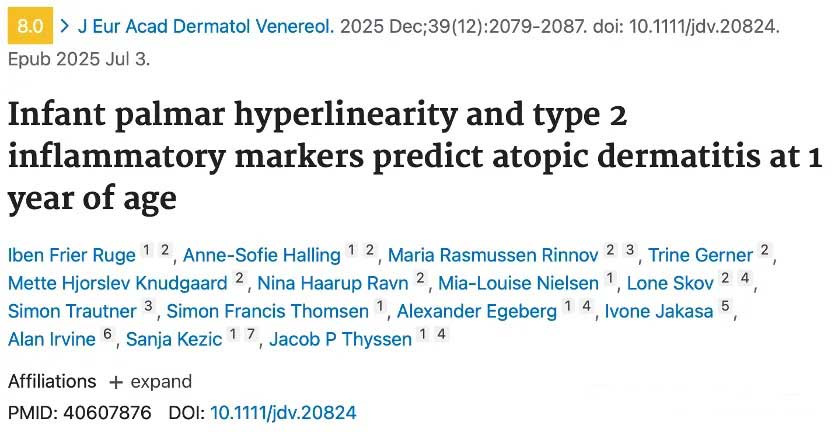
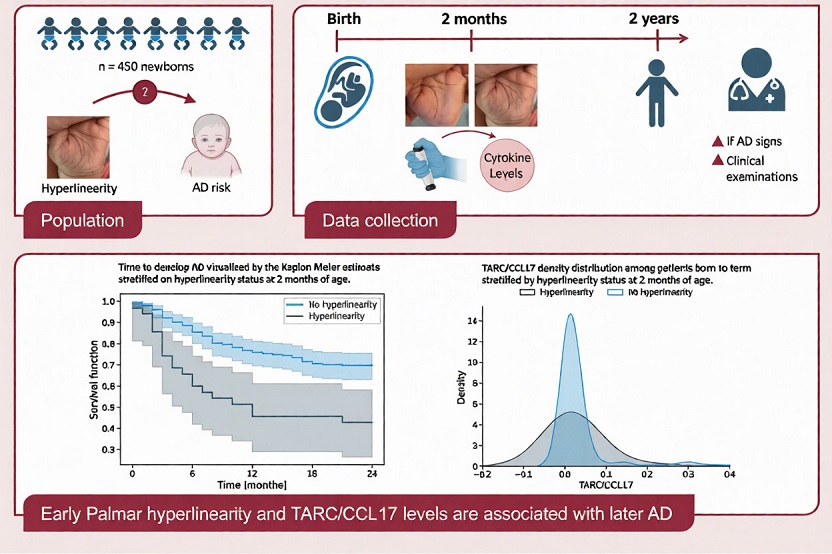
An innovative cohort study explored early-life predictors of AD development.
Key observation: Palmar crease thickening at 2 months of age
Risk association:
AD development at 1 year: HR 2.82
Combined with TARC/CCL17 biomarkers: HR increased to 5.66
Clinical value:
This simple, non-invasive screening approach may enable earlier identification of high-risk infants and facilitate preventive intervention strategies.
3. Metabolic Disease and Inflammatory Skin Disorders
Source: JAAD + JEADV
Emerging evidence highlights the dual dermatologic benefits of GLP-1 receptor agonists.
Mechanism:
Direct inhibition of the NF-κB pathway
Downregulation of TNF-α, IL-17, and IL-23
Clinical outcomes:
Improvement in psoriasis and hidradenitis suppurativa lesions
Target population:
Patients with inflammatory dermatoses complicated by metabolic comorbidities.
4. Management of Refractory Atopic Dermatitis
Source: JEADV – Real-World Evidence
Therapeutic strategy: Lebrikizumab as rescue therapy
Indication: AD refractory to upadacitinib
Outcome: Favorable real-world effectiveness
Clinical relevance:
Provides an alternative pathway for patients who fail JAK inhibitor therapy.
II. Optimization of Alopecia Areata Treatment
1. Sequential JAK Inhibitor Therapy
Source: JAMA Dermatology
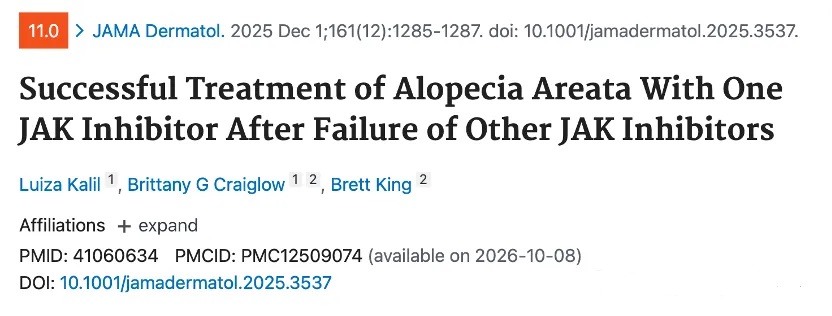
Principle: Failure of one JAK inhibitor does not preclude response to another
Evidence:
13 patients achieved significant hair regrowth after switching agents
Available options:
Ritlecitinib, baricitinib, upadacitinib
Clinical takeaway:
Sequential therapy expands treatment flexibility for refractory alopecia areata.
2. Combination Therapy Approaches
Source: JEADV – Real-World Study
Regimen: Baricitinib combined with corticosteroids
Results: Superior efficacy compared to monotherapy
Safety: Well tolerated
Indication:
Moderate to severe alopecia areata.
III. Standardization in Aesthetic Dermatology
1. Expert Consensus on Skincare Ingredients
Source: JAAD – Delphi Consensus Study
| Indication | Recommended Ingredients | Consensus Level |
|---|---|---|
| Anti-aging | Retinoids, peptides | 100% agreement |
| Skin brightening | Niacinamide, vitamin C | High agreement |
| Moisturization | Hyaluronic acid | Unanimous |
| Acne control | Salicylic acid, benzoyl peroxide | Standardized |
This framework provides clinicians with evidence-based guidance amid a saturated skincare market.
2. Emerging Technologies and AI Limitations
Source: JAAD + JEADV
Current challenge:
Underrepresentation of darker skin tones (10.2%)
Diagnostic accuracy only 15%
Future direction:
Diverse training datasets
Ethical and regulatory oversight
Clinical implication:
Ensuring fairness and reliability in AI-assisted dermatologic diagnosis remains critical.
IV. Precision Management in Skin Oncology
1. New Insights into Melanoma
Source: JAAD – Prospective Study
Finding:
Patients with BMI ≥30 kg/m² diagnosed at earlier stages (OR 1.93)
Explanation:
Increased healthcare utilization leading to earlier detection
Conclusion:
Obesity is not an independent adverse prognostic factor in melanoma.
2. Optimized Therapy for Basal Cell Carcinoma
Source: JAAD – Phase III Trial
Treatment:
10% 5-aminolevulinic acid gel + red light PDT
Design:
Randomized, double-blind, multicenter
Indication:
Superficial BCC
V. Safety Considerations in Acne Treatment
1. Growth and Development Outcomes
Source: JAAD – Large Cohort Study
Isotretinoin findings:
No impact on final adult height
Temporary growth velocity reduction during treatment
Clinical guidance:
Standard dosing regimens remain safe; caution warranted in very young patients receiving high doses.
2. Topical Therapy–Related Shedding
Source: JAAD – Multicenter Prospective Study
Minoxidil-induced shedding:
Onset: ~2 weeks
Peak: 4 weeks
Recovery: By 12 weeks
Patient education:
Crucial to prevent unnecessary discontinuation.
VI. Innovations in Neuromodulatory Therapies
Transcutaneous Auricular Vagus Nerve Stimulation (taVNS)
Source: JAMA Dermatology – High-Quality RCT
Indication: Rosacea
Benefits:
Reduced erythema and flushing
Improvement in anxiety, depression, sleep quality, and migraine
Durability: Sustained at 24 weeks
Safety: Rare adverse events
VII. Drug Safety Surveillance
1. Cardiovascular Risk with JAK Inhibitors
Source: JEADV – Global Cohort
Monitoring focus:
Cardiovascular events
Thromboembolic risk
Clinical approach:
Individualized risk–benefit assessment
2. Infection Risk: Biologics vs JAK Inhibitors
Source: JEADV – BioDay Study
Provides comparative safety data to inform therapeutic decision-making in AD.
VIII. Translational Innovation and Digital Dermatology
Multi-task AI diagnostic models
Large language models in hidradenitis suppurativa assessment
Dermoscopy + AI workflows
Advanced digital imaging, including line-field confocal OCT
Real-World Evidence Highlights
| Topic | Data Source | Sample Size | Key Finding |
|---|---|---|---|
| Dupilumab infection risk | TriNetX | 10,913 | 39–68% risk reduction |
| Infant AD prediction | Danish cohort | 245 | HR 5.66 |
| Isotretinoin growth | Rochester cohort | 2005–2021 | No effect on adult height |
| Minoxidil shedding | Multicenter | 142 | Reversible by 12 weeks |
| GLP-1RA skin benefits | Systematic reviews | Multiple | Multi-target anti-inflammatory effects |
Editorial Summary
This integrated review synthesizes high-impact dermatology research from JAAD, JAMA Dermatology, and JEADV, emphasizing clinically actionable insights supported by randomized trials, real-world evidence, and expert consensus.
Core value:
Bridging research and practice
Supporting evidence-based decision-making
Advancing patient-centered dermatologic care
Disclaimer:
This content is intended for medical professionals. Clinical decisions should be made based on individual patient characteristics and current clinical guidelines.